


Cannabis Terpenes: A Guide to Aroma and Flavour
24/10/2026
Pattaya’s Cannabis Scene After the 2025 Rules
24/10/2026Last updated October 2026.
This guide focuses on Thailand: what Thai traffic law says about driving under the influence, where cannabis fits, and the penalties. The short version is simple: do not drive, or ride a motorbike, after using cannabis.
At a glance
- Thai law bans driving while intoxicated by liquor or other intoxicating substances.
- A separate offence covers drivers who use narcotics, including extracts over 0.2% THC.
- We have not found a published THC limit for drivers in Thai law.
- Penalties include prison, fines and licence suspension or revocation.
- In Pattaya, use taxis, songthaews or ride-hailing apps instead.
What Thai traffic law says
The Land Traffic Act
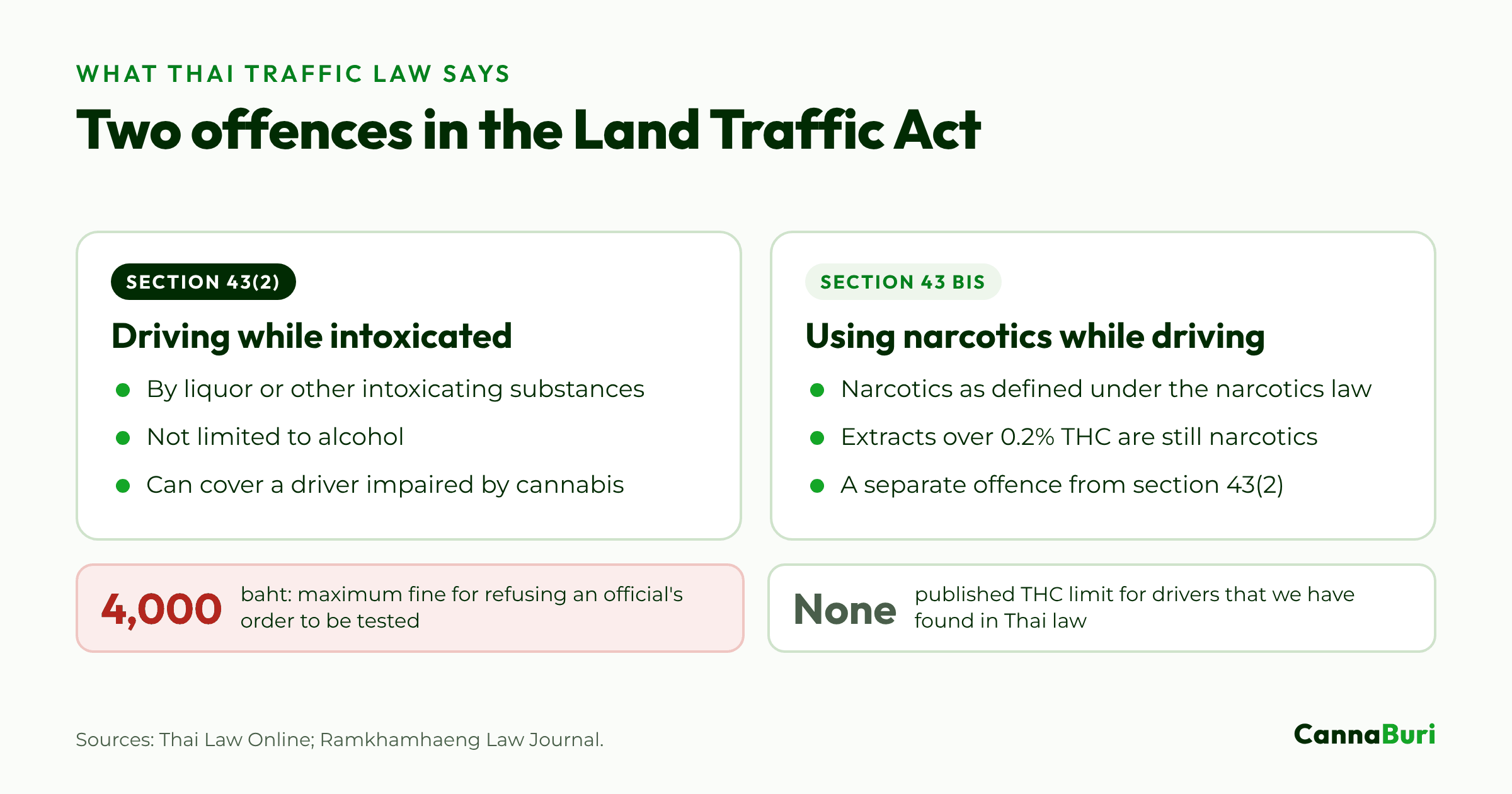
Driving offences involving alcohol and drugs are set out in the Land Traffic Act B.E. 2522 (1979). Two sections matter here:
- Section 43(2): prohibits driving while intoxicated by liquor or other intoxicating substances. In Thai, the phrase is “ของเมาอย่างอื่น”. The wording is not limited to alcohol.
- Section 43 bis: prohibits a driver from using narcotics as defined under the narcotics law. Thai Law Online notes that this is a separate offence from section 43(2), so the drink-driving penalties should not be assumed to apply to it.
The law also gives officers powers to test drivers. Refusing an official’s order to be tested under section 43 bis or 43 ter is itself an offence, with a fine of up to 4,000 baht.
Where cannabis fits
Since 9 June 2022, cannabis has not been on Thailand’s Category 5 narcotics list. Cannabis flower is now regulated as a controlled herb. However, cannabis extracts containing more than 0.2% THC by weight are still controlled as narcotics.
In practice, that means a driver impaired by cannabis could face action under section 43(2), as a person intoxicated by an “other intoxicating substance”, and a driver who has used a high-THC extract could also fall under the narcotics provisions in section 43 bis. Which section applies in a particular case depends on the facts, and is ultimately for the police and the courts to decide. We have not found a published THC limit for drivers in Thai law, so there is no “safe” figure to rely on.
The penalties
Driving while intoxicated (section 43(2))
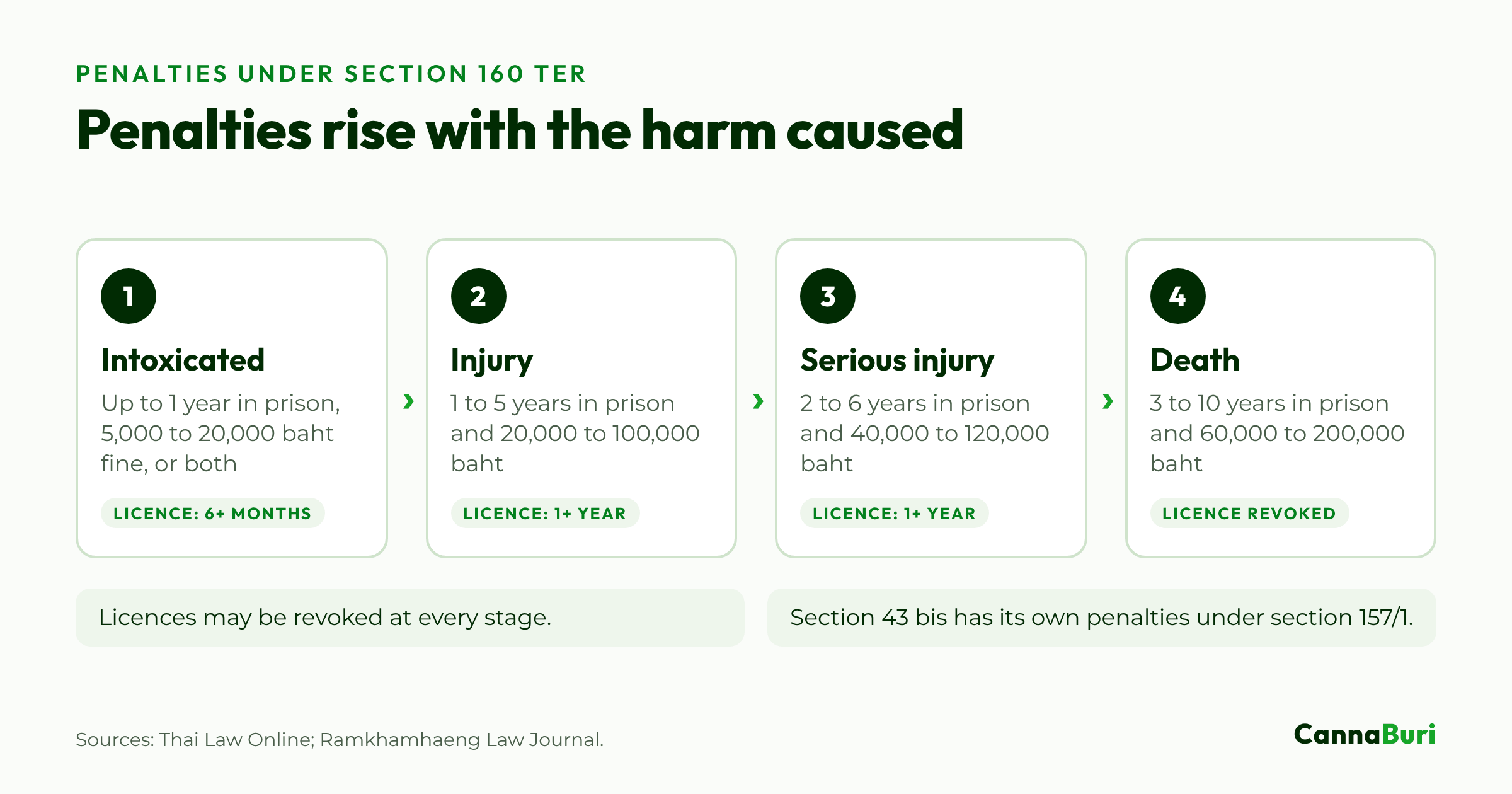
The penalty, set out in section 160 ter, is up to one year in prison, a fine of 5,000 to 20,000 baht, or both. The court must also suspend the driving licence for at least six months or revoke it. The penalties rise sharply if someone is hurt:
- Causing injury: one to five years in prison and a fine of 20,000 to 100,000 baht, with the licence suspended for at least a year or revoked.
- Causing serious injury: two to six years in prison and a fine of 40,000 to 120,000 baht, with the licence suspended for at least a year or revoked.
- Causing death: three to ten years in prison and a fine of 60,000 to 200,000 baht, with the licence revoked.
Using narcotics while driving (section 43 bis)
Under section 157/1, the penalty is one-third higher than the penalty under the narcotics law, and the court must suspend the licence for at least six months or revoke it. Where someone is injured, seriously injured or killed, prison terms of one to ten years apply, depending on the harm caused, along with heavy fines and licence suspension or revocation.
Penalties may get tougher
A study published in the Ramkhamhaeng Law Journal in June 2026 argued that these penalties are too low compared with Japan and England, and recommended tougher, standalone legislation. The draft Cannabis Control Bill approved by the Cabinet on 22 September 2026 also promises tougher penalties for cannabis offences, although it is not yet law. Expect enforcement to become stricter, not more relaxed.
Why the advice is simply “don’t drive”
The US Centers for Disease Control says cannabis can slow reaction time and decision-making, impair coordination and distort perception, all of which are needed to drive safely. It also notes that combining cannabis with other substances, such as alcohol, can increase impairment.
Timing is hard to judge, too. According to the Canadian Centre on Substance Use and Addiction, the effects of edible cannabis can take 30 minutes to two hours to begin, peak at around four hours, and last up to 12 hours. Feeling fine after a meal is not a reliable sign that you are fit to drive later that day.
Practical tips for Pattaya
- Plan your transport first: Pattaya has taxis, songthaews and ride-hailing apps. Use them.
- Motorbikes and scooters count: the Land Traffic Act applies to anyone driving a vehicle on the road, including a hired scooter.
- Boats and jet skis: do not operate either after using cannabis.
- Ask your practitioner: if you have a prescription, ask the practitioner who issued it how it affects driving, work and other activities.
- Look after friends: if someone in your group has used cannabis, offer to share a taxi.
Other rules apply after you leave a dispensary too, such as no smoking in public. Read our guide to cannabis rules in Thailand for visitors and our etiquette guide for Pattaya.
Key takeaways
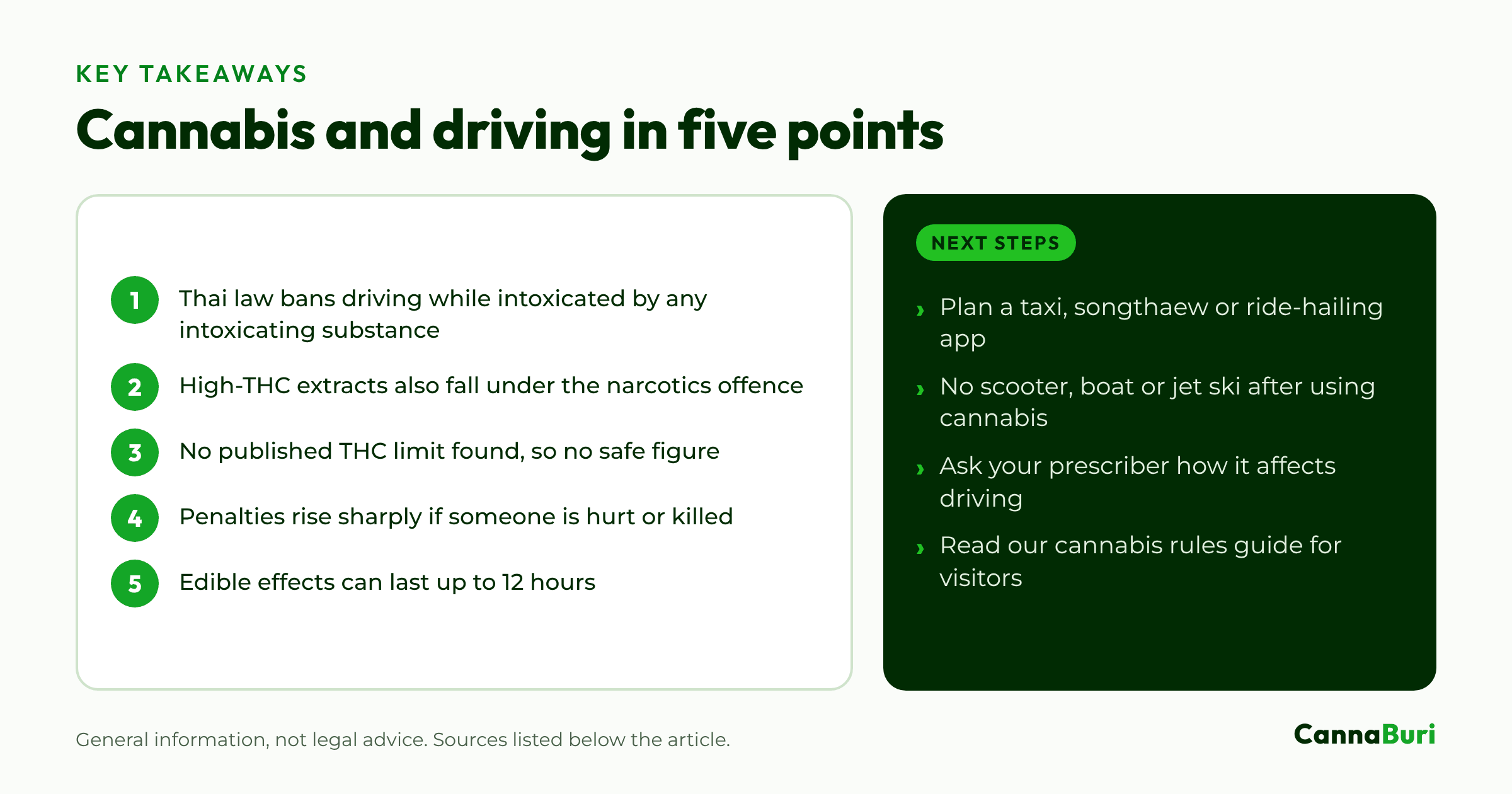
If you have questions about Thailand’s cannabis rules, you are welcome to visit our store on Pattaya 3rd Road or contact the CannaBuri team. We are happy to explain what the law says.
This article is general information, not legal or medical advice.
Sources
- Ramkhamhaeng Law Journal: Penalty Measures for Violations under Section 43(2) and Section 43 bis of the Land Traffic Act B.E. 2522 (2026)
- Thai Law Online: DUI laws and penalties in Thailand
- Thai Law Online: Is Marijuana Legal in Thailand? Cannabis Laws in 2026 Explained
- ThaiCannaMed: Cannabis in Thailand in 2026: What Is Actually Legal?
- The Nation: Thai cabinet endorses draft cannabis control bill for medical use
- CDC: Cannabis Health Effects
- Canadian Centre on Substance Use and Addiction: 7 Things You Need to Know About Edible Cannabis
