
Cannabis Cloning Explained: How Growers Take Cuttings
24/10/2026
Thailand’s Cannabis Control Bill: What the Draft Law Would Change
27/10/2026Last updated October 2026. This article is general information only, not legal or medical advice.
Visitors to Pattaya often see the words “hemp” and “cannabis” used side by side, sometimes as if they mean the same thing. Botanically they are very close relatives, but Thai law draws a clear line between them, and that line affects what you can buy, what can go into food and cosmetics, and what you can take home. This guide explains the difference in plain terms.
Same plant family, different purposes
Hemp and cannabis are usually classed as varieties of one species, Cannabis sativa. The difference lies mainly in how they are bred and what they are grown for.
- Cannabis varieties are bred for their flowers, which can contain high levels of THC (tetrahydrocannabinol), the compound responsible for the “high”. Britannica notes that some varieties can contain 25 percent THC or more.
- Hemp is grown for fibre and for products made from the plant, such as foods, drinks, personal care items and CBD (cannabidiol). It contains very little THC.
Because the two plants can look alike, the practical difference is measured in a laboratory rather than by eye.
How Thai law defines hemp and cannabis
Thailand uses botanical subspecies and a THC limit to separate the two. According to the law firm Tilleke & Gibbins:
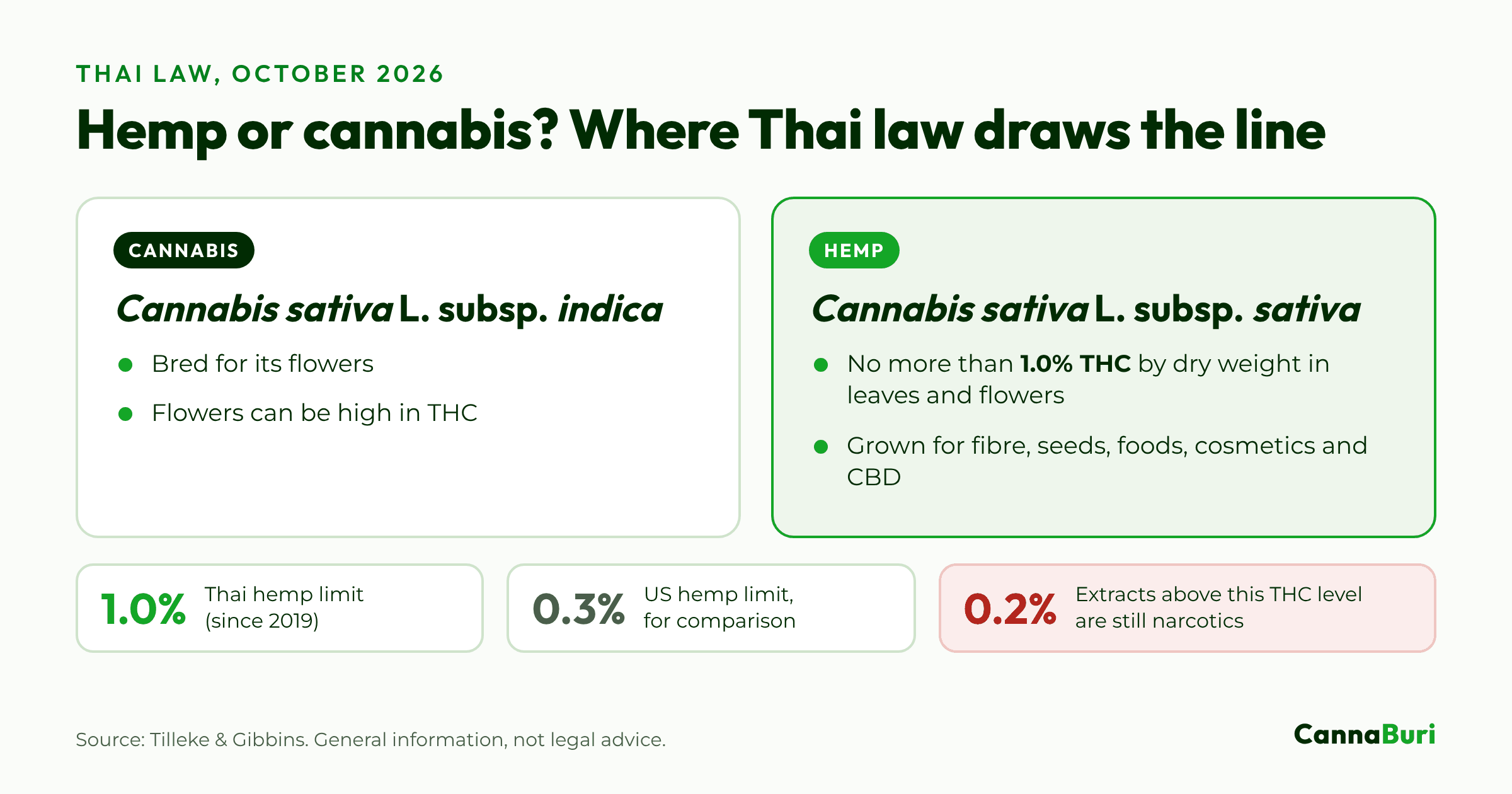
- Cannabis is defined as Cannabis sativa L. subsp. indica.
- Hemp is defined as Cannabis sativa L. subsp. sativa with no more than 1.0% THC by dry weight in its leaves and flowers.
That 1% threshold has been in place since an October 2019 notification, which replaced an earlier 0.5% limit. It is higher than the 0.3% figure used to define hemp in the United States, so a product described as “hemp” abroad and one described as hemp in Thailand are not measured against the same standard.
What changed in 2022 and 2025
Delisting in June 2022
Until 9 June 2022, both cannabis and hemp were Category 5 narcotics. On that date Thailand removed both plants and their unprocessed parts from the Narcotics Code. Extracts were treated differently: cannabis and hemp extracts containing more than 0.2% THC are still regulated as narcotics.
A ministerial regulation on extracts took effect on 26 April 2026. It limits extracts above 0.2% THC to four purposes: medical use, analysis and research, industrial use, and narcotics suppression.
Cannabis flower became a controlled herb in June 2025
On 26 June 2025, the Ministry of Public Health classified cannabis flowers as a controlled herb. Flower can still be sold by licensed shops, but only to buyers who hold a cannabis sales licence or a prescription or medical certificate from a Thai-licensed practitioner. Shops may supply only enough for personal use over 30 days, and suppliers must hold GACP certification. You can read more about GACP and lab reports in our guide What GACP and CoA Mean When Choosing Cannabis in Thailand.
The notification names cannabis flowers. The sources we read do not say clearly whether hemp flower is treated in exactly the same way, so if you are unsure about a particular product, ask a licensed shop or a Thai legal professional.
Hemp in food and cosmetics
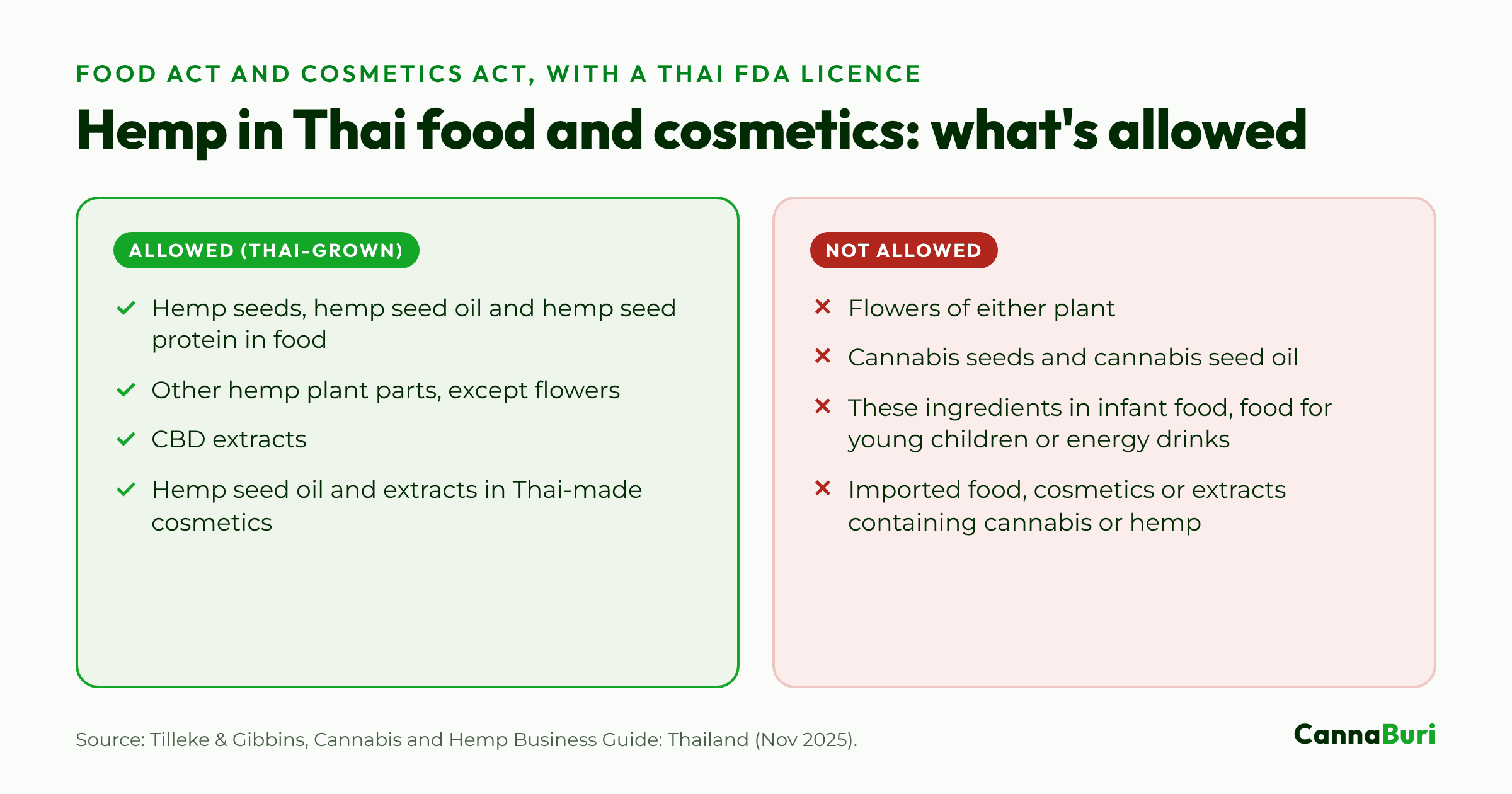
This is where the hemp and cannabis distinction matters most in everyday life. Under the Food Act and the Cosmetics Act, with a Thai FDA licence:
- Food may contain Thai-grown hemp seeds, hemp seed oil, hemp seed protein, other plant parts (except flowers) and CBD extracts. These ingredients are not allowed in infant food, food for young children or energy drinks.
- Cosmetics made in Thailand may use Thai-grown hemp seed oil, extracts, plant parts (except flowers) and CBD extracts.
- Not allowed: cannabis seeds, cannabis seed oil, and the flowers of either plant may not be used in food. Cannabis seeds, seed oil and flowers are also barred from cosmetics.
Importing food or cosmetics that contain cannabis or hemp ingredients is prohibited, and so is importing cannabis or hemp extracts and oils. If you want to understand the chemistry behind the two best-known compounds, see our article CBD vs THC: Chemistry, Legal Status and Lab Labels.
A note on health: hemp and CBD products are regulated as foods and cosmetics in Thailand, not as treatments. If you have questions about how any product might affect your health, please consult a Thai-licensed medical practitioner.
Growing hemp and cannabis
According to Tilleke & Gibbins, Thai nationals may grow cannabis and hemp without a licence, and hemp growers must register on the Thai FDA’s PlookGanja app. Agricultural activities are reserved for majority Thai-owned companies, and flower intended for sale or export must come from a GACP-certified site.
Rules that apply whichever plant you mean
Whether a product is labelled hemp or cannabis, a few rules are worth keeping in mind:
- Age: the minimum age to buy, possess and use cannabis in Thailand is 20.
- Public smoking: cannabis smoke is treated as a public nuisance. Under the Public Health Act 1992, smoking in public can lead to a fine of up to 25,000 baht, up to three months in prison, or both.
- Travel: taking cannabis across an international border is a serious criminal offence. Do not pack cannabis or cannabis products in your luggage, and remember that the country you are travelling to has its own laws. Our guide Cannabis Rules in Thailand for Visitors covers this in more detail.
Is the law changing again?
Very possibly. On 22 September 2026 the Thai cabinet approved a draft cannabis control bill. As reported by The Nation, it would limit cannabis use to medical purposes with a doctor’s prescription, require cultivation plots to be registered, and require existing cannabis shops to become medical facilities in order to renew their licences. The bill now goes to the House of Representatives, so its final form is not yet known. We will update this article if the rules change.
Quick summary
- Hemp and cannabis are close relatives within Cannabis sativa.
- In Thailand, hemp means the sativa subspecies with no more than 1.0% THC by dry weight in its leaves and flowers.
- Both plants were removed from the narcotics list in 2022, but extracts above 0.2% THC are still narcotics.
- Since June 2025, cannabis flower is a controlled herb and needs a prescription or medical certificate.
- Hemp seeds, seed oil and some other parts can be used in licensed foods and cosmetics. Flowers cannot.
- No public smoking, nobody under 20, and nothing across borders.
If you have questions about anything in this guide, you are welcome to visit our team at CannaBuri on Pattaya 3rd Road or get in touch with our staff. We are always happy to explain how things work.
Sources
- Britannica, “What Is the Difference Between Hemp and Marijuana?”: britannica.com
- Tilleke & Gibbins, “Cannabis and Hemp Business Guide: Thailand” (10 November 2025, via Mondaq): mondaq.com
- Tilleke & Gibbins, “Thailand Clarifies Legal Definition of Hemp” (November 2019): tilleke.com
- The Nation, “Thai cabinet endorses draft cannabis control bill for medical use” (23 September 2026): nationthailand.com
- Associated Press, “Thailand starts banning the sale of cannabis without a prescription” (27 June 2025): clickondetroit.com
- Cannabis for Thailand, “Thailand Cannabis Laws 2026” (updated 27 September 2026): cannabisforthailand.com
- Wikipedia, “Cannabis in Thailand”: wikipedia.org
