

How to Check a Cannabis Shop Is Licensed in Thailand
10/11/2026Last updated November 2026.
Since June 2025, licensed shops in Thailand may only supply cannabis flower to people who hold a valid prescription, and the government’s November 2026 inspections show that rule is being enforced. Yet many visitors and residents are still unsure what a prescription actually is, who can write one and how long it lasts. This guide explains how cannabis prescriptions work in Thailand today, including how telemedicine services such as Botanic RX fit in.
At a glance
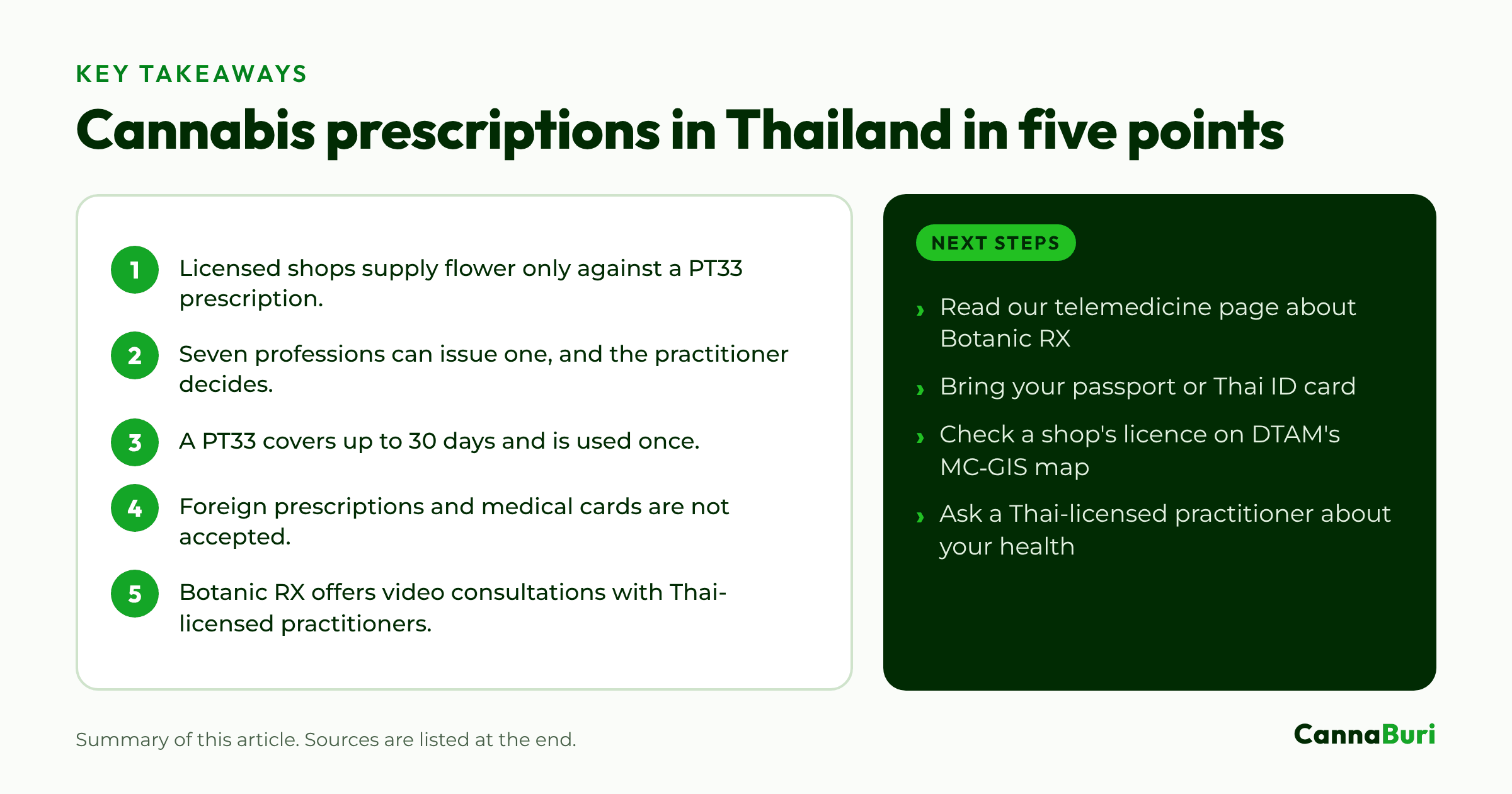
- Licensed shops may supply cannabis flower only against a PT33 prescription.
- Seven professions can issue one, and the practitioner decides whether it is suitable.
- A PT33 covers no more than 30 days and is used once, with no refills.
- Prescriptions and medical cards from other countries are not accepted.
- Botanic RX offers video consultations with Thai-licensed practitioners, with the PT33 collected at a partner shop.
Why a prescription is now required
A Ministry of Public Health notification dated 26 June 2025 made cannabis flower a controlled herb. Under it, a licensed shop may sell flower only to a person who presents a prescription on the official PT33 form, and walk-in sales without a prescription are prohibited. According to the law firm Tilleke & Gibbins, a shop that breaks this rule faces up to one year in prison or a fine of up to 20,000 baht, and its licence can be suspended.
Enforcement has stepped up through 2026. In November the government said inspections of Thailand’s 12,279 licensed dispensaries had found breaches including non-prescription sales and online sales, with licence suspensions of 30 to 90 days for first offences and immediate revocation for serious or repeat ones. For buyers, the practical message is simple: a licensed shop will ask to see your prescription and your ID every time.
Who can issue a prescription
The 2025 rules allow seven professions to issue a PT33. Each practitioner must hold a current Thai licence in their own field:
- Medical doctors: licensed by the Medical Council of Thailand.
- Dentists and pharmacists: each licensed in their own profession.
- Thai traditional and applied Thai traditional medicine practitioners: two separate licensed professions.
- Chinese medicine practitioners: licensed to practise in Thailand.
- Folk healers: registered folk healers who specialise in herbal medicine.
The practitioner decides independently whether cannabis is appropriate, and may decline. The Department of Thai Traditional and Alternative Medicine (DTAM) has set out the conditions for which practitioners may prescribe, and reports in 2025 described the list being revised more than once. In September 2025, around 3,693 practitioners had been trained to issue PT33 prescriptions.
This article explains how prescriptions work, not whether cannabis is suitable for any condition. If you have questions about your health, please speak to a Thai-licensed medical practitioner.
What a PT33 shows and how long it lasts
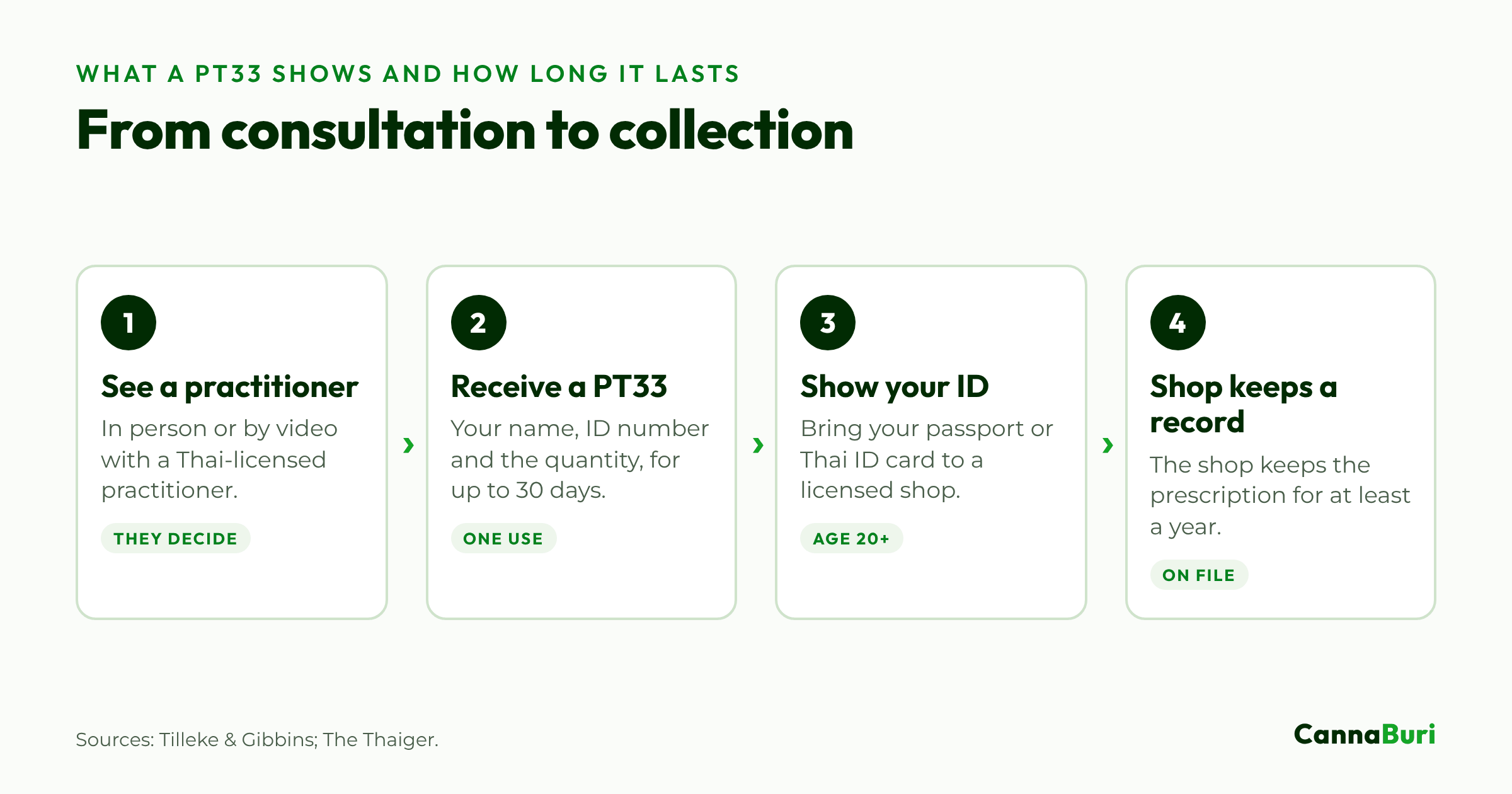
A PT33 is a standard form, so every valid prescription carries the same core details. Reporting by The Thaiger lists the practitioner’s licence number together with the patient’s name, age, nationality and ID number, the diagnosis and the dosage. The prescription covers a stated quantity for no more than 30 days, and it is single-use, so it cannot be refilled.
At the counter, the shop checks the prescription against your passport or Thai ID card. It must keep every prescription for at least one year and show it to DTAM or the police on request, and licensed shops also report their stock and sales to DTAM every month on forms known as PT27 and PT28. A few points follow from this:
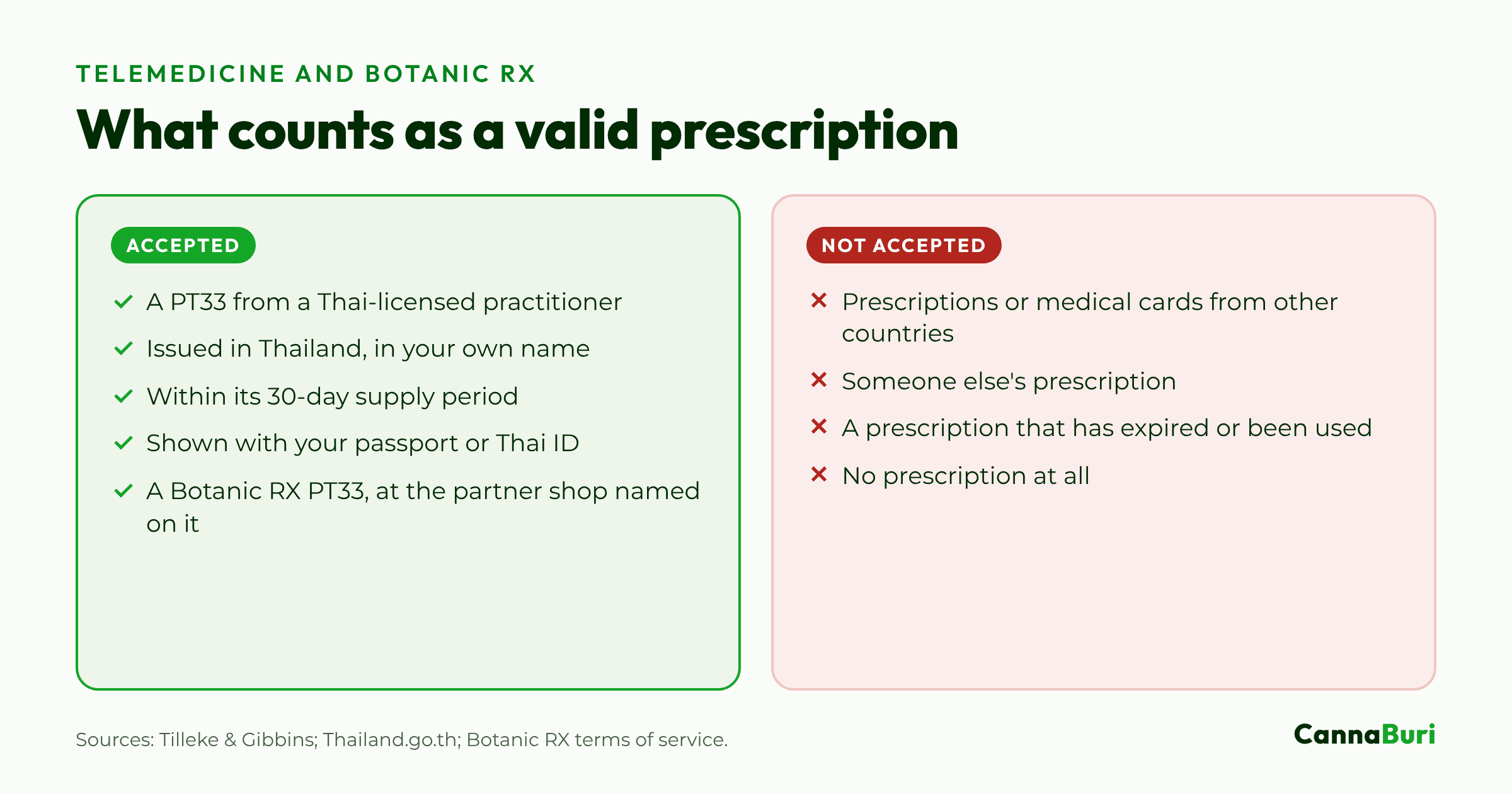
- Thai prescriptions only: prescriptions and medical cannabis cards from other countries are not accepted, so visitors need a prescription issued in Thailand.
- Your name only: a prescription is issued to one person and cannot be shared or used by someone else.
- One visit, one supply: once a prescription has been dispensed it cannot be used again, and a new supply needs a new prescription.
- Age 20 and over: CannaBuri only serves adults aged 20 and over, and does not supply women who are pregnant or breastfeeding.
Telemedicine and Botanic RX
Telemedicine is legal in Thailand within set limits. A 2020 Medical Council notification and a 2021 Ministry of Public Health standard allow licensed practitioners to consult remotely, but the service must run from a registered medical facility and keep proper registration details and medical records. The June 2025 cannabis notification itself does not mention video consultations, and the government has said it is building a telemedicine system that links prescriptions to a central database.
Botanic RX is a Thai telemedicine service that CannaBuri works with. It describes itself as connecting patients with Thai-licensed practitioners and licensed partner shops, and says it works under the current Ministry of Public Health rules for PT33 prescriptions. It is run by a Thai traditional medicine clinic, according to its privacy notice. The process works like this:
- Register: sign up with a Thai ID card or, for foreign visitors, a passport. You must be 20 or over.
- Consult by video: talk to a practitioner from your phone or computer. The practitioner decides from your history and may decline or advise an in-person visit.
- Receive the PT33: if one is issued, it appears in your account with a QR code that shows whether it is valid, expired, cancelled or already dispensed.
- Collect: show the QR code and your original ID at the partner shop named on the prescription. It cannot be used at shops outside the system.
At CannaBuri you can also start the process in store, where our team can help you register and connect to the practitioner on duty. Our telemedicine page explains how Botanic RX works with CannaBuri step by step. Whichever route you choose, the consultation is a medical decision, not a formality, and the practitioner may say no.
Practical points before you visit
A little preparation makes the process quicker, whether you see a practitioner in person or online. Keep these points in mind:
- Bring your original ID: a passport for visitors or a Thai ID card for residents, every time you collect.
- Be open with the practitioner: mention any allergies and long-term conditions.
- Use a licensed shop: our guide on how to check a cannabis shop is licensed explains how to use DTAM’s map.
- Keep it in Thailand: a Thai prescription does not allow you to take cannabis out of the country.
For the wider rules on buying, including what happens inside a licensed dispensary, see our guide to buying cannabis in Pattaya.
Key takeaways
Prescriptions are now the foundation of how cannabis is supplied in Thailand, and understanding them saves time at the counter. If you have questions about how the process works, you are welcome to visit our store on Pattaya 3rd Road or contact our staff.
This article is general information, not legal or medical advice.
Sources
- Thailand’s New Cannabis Controls Impact Doctors, Dispensaries, and Growers, Tilleke & Gibbins (3 September 2025)
- Thailand’s Cannabis Reset: Dispensaries to Clinics, Tilleke & Gibbins (8 January 2026)
- Thai cannabis prescriptions standardised, symptoms list clarified, The Thaiger (1 July 2025)
- Thai Health Ministry Tightens Medical Cannabis Rules, The Nation (1 September 2025)
- Cannabis restricted to five medical uses, health authorities say, The Phuket News (2 September 2025)
- Thailand Tightens Cannabis Regulations Nationwide, Thailand.go.th (9 November 2026)
- Cannabis Now Strictly Regulated in Thailand: Important Notice for Tourists, Thailand.go.th (June 2025)
- The Rapid Growth of Telemedicine Startups to Combat COVID-19, Kudun & Partners via Legal 500
- Botanic RX, home page and patient guide
- Botanic RX terms of service and privacy notice
