
Mould on Cannabis: How to Spot It and Why Testing Matters
24/10/2026
Why Cannabis Seedlings Struggle: Common Causes Explained
24/10/2026Last updated October 2026.
Hash has been made for centuries, and it still raises the same question: how do you know what you are getting? This guide explains what hash is, how its quality is judged, what adulteration looks like, and why lab testing matters more than anything you can see or smell.
At a glance
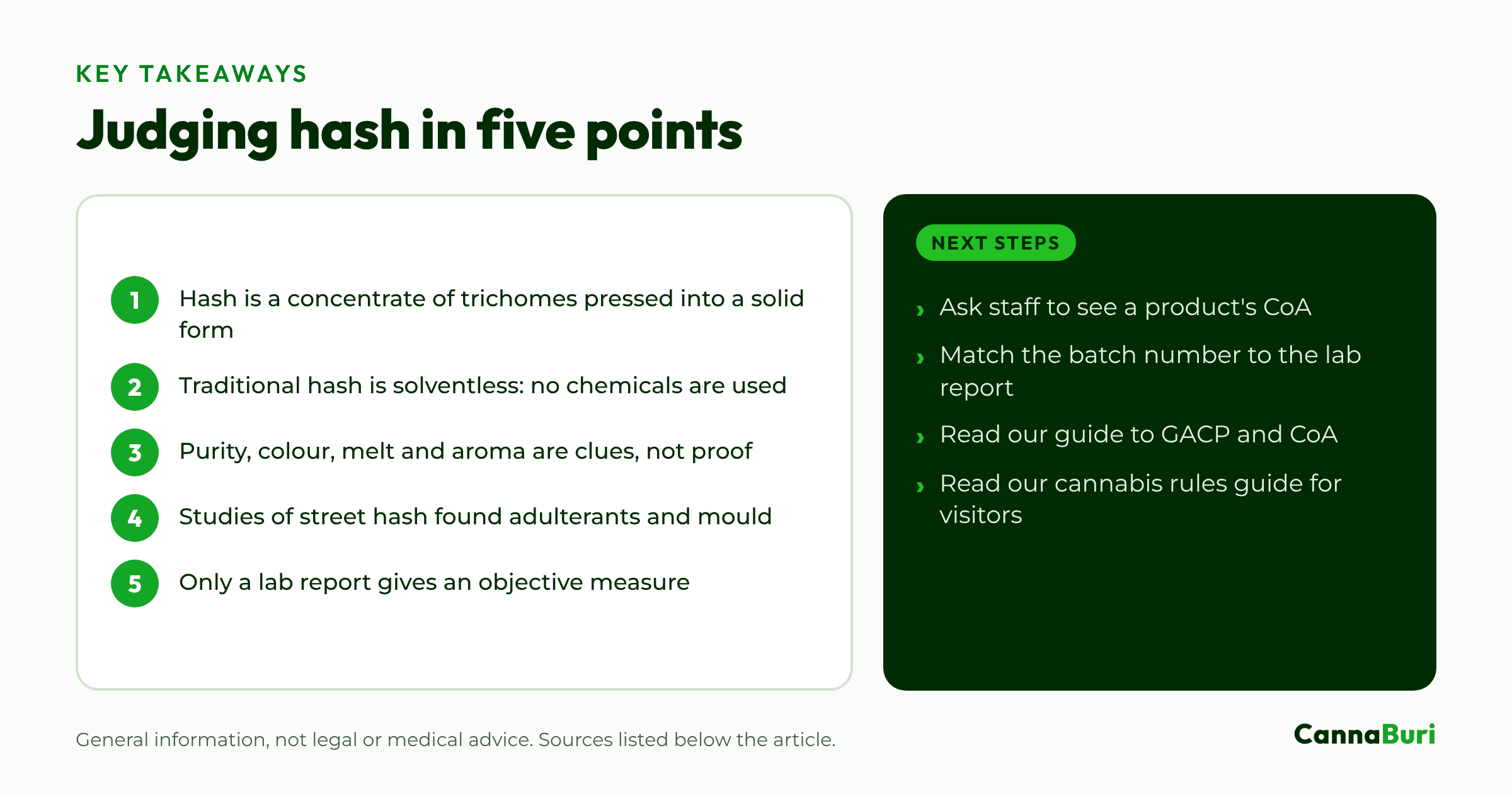
- Hash is a concentrate made from trichomes, pressed into a solid or semi-solid form.
- Traditional hash is solventless: made by hand-rubbing, dry sifting, ice water and pressing.
- Purity, colour, texture, melt and aroma are clues to quality, but none is proof on its own.
- A 2019 Madrid study judged 88.3% of street hashish samples not suitable for consumption.
- Microbes, pesticides and synthetic cannabinoids are invisible; only lab testing can show them.
What hash is and how it is made
Hash (short for hashish, a word Leafly traces to Arabic, roughly meaning “grass”) is a concentrate made from trichomes, the tiny sticky resin glands on the cannabis plant. The trichomes are separated from the plant material and pressed into a solid or semi-solid form. Its strength, smell and other properties depend largely on the genetics of the plant it came from.
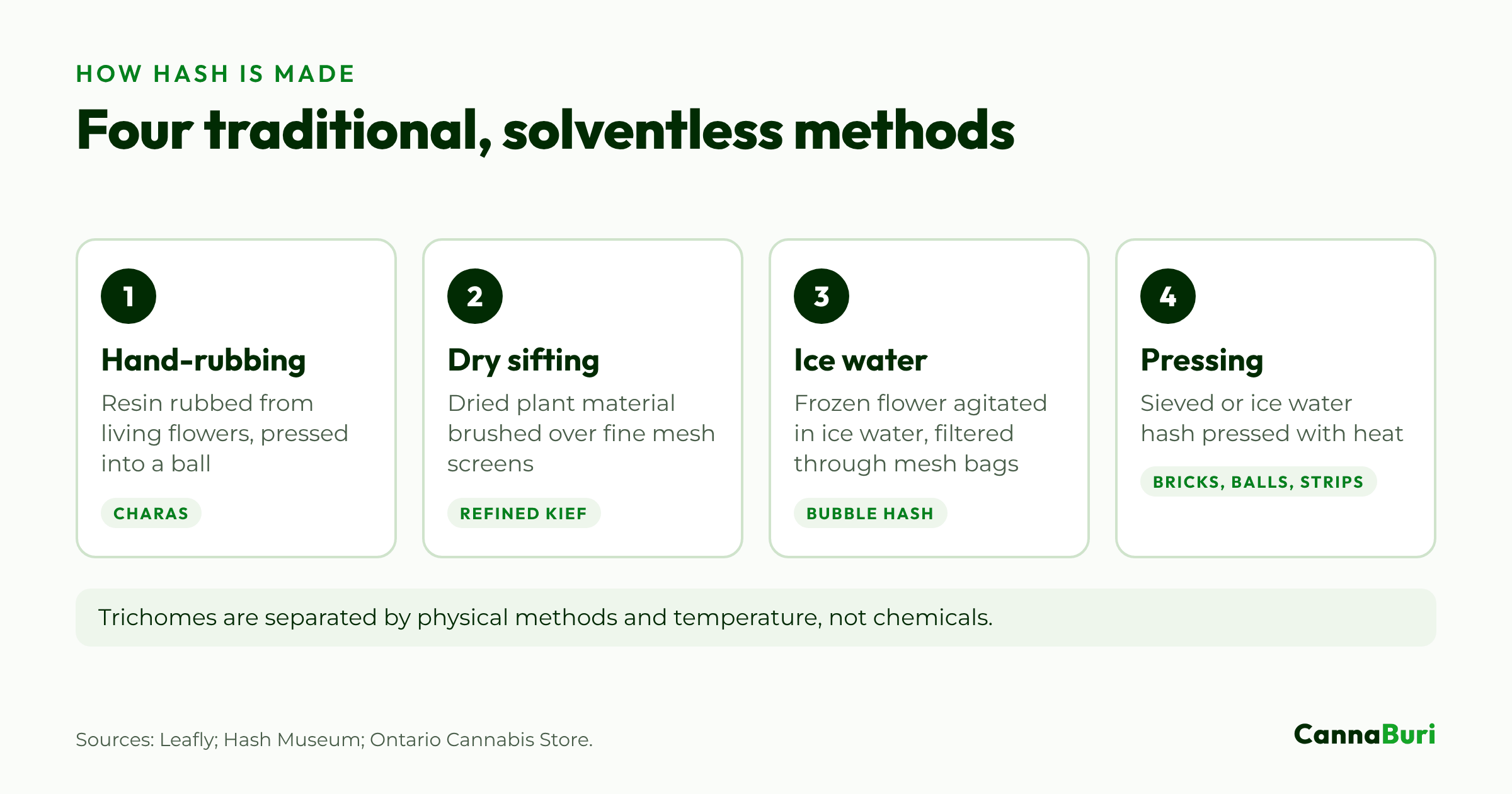
Traditional hash is solventless: the trichomes are separated by physical methods and temperature, not chemicals. The main methods are:
- Hand-rubbing (charas): hands are rubbed over the flowers of living plants, and the resin is scraped off the palms and pressed into a ball. The Hash Museum describes it as usually dark brown or black, slightly sticky and soft at room temperature.
- Dry sifting: dried plant material is brushed over fine mesh screens so the trichomes fall through. The result is essentially refined kief.
- Ice water (bubble hash): frozen flower is agitated in ice water, and the trichomes are filtered through a series of fine mesh bags. Leafly notes this method became popular in the late 1990s.
- Pressing: sieved or ice water hash is pressed with heat into bricks, balls or strips, making it denser and harder.
How quality is judged
Producers and experienced buyers look at several things together. None of them is proof on its own, and only one of them is objective.
Purity, colour and texture
Good hash is mostly trichome heads with as little plant material as possible. Plant matter adds chlorophyll and dilutes the resin, and the Ontario Cannabis Store notes that more plant material can shift the colour towards green.
Colour ranges from light golden to dark brown or black, depending on the method, the plant and how the hash was pressed and stored. Texture runs from dry and crumbly to soft and sticky. Dark colour is not automatically a bad sign, since traditional charas is usually dark; what matters is that colour and texture fit the method claimed.
Melt and grading
For ice water hash, a common measure is how cleanly it melts when heated. Leafly describes “full-melt” hash as melting almost completely and leaving little residue. Ice water hash is often graded on a star system, with six stars as the most refined and one star as the lowest.
Aroma and lab results
Fresh, well-made hash keeps the terpenes of the plant it came from, so it should smell of cannabis: earthy, spicy, fruity or floral depending on the strain. The Ontario Cannabis Store lists sensory testing alongside lab testing as part of quality control.
Lab results are the only objective measure. Licensed producers test for potency, pesticides, contaminants and microbes at several stages.
Warning signs of adulteration
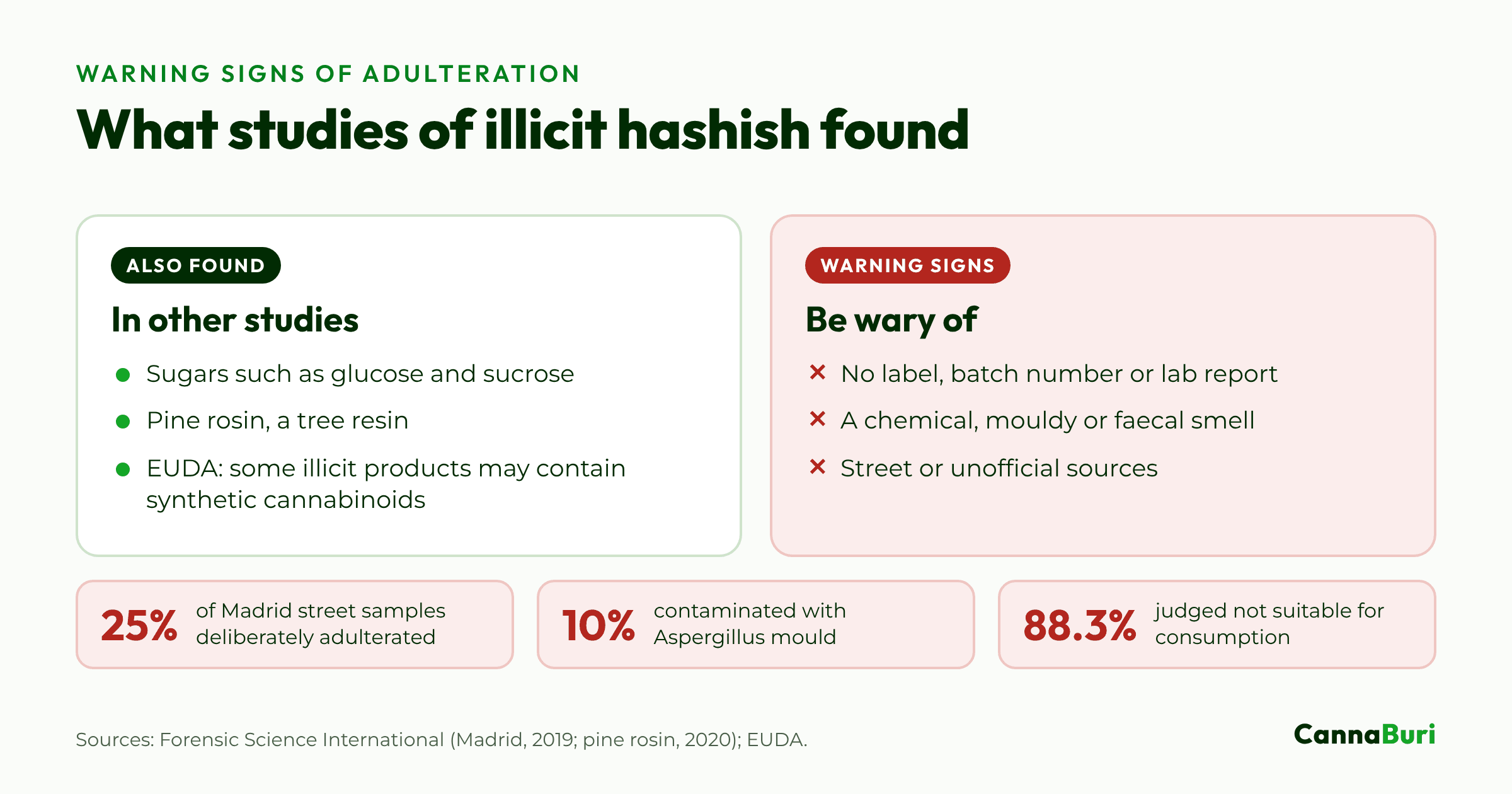
Adulterated and contaminated hash is a well-documented problem in illicit markets. A 2019 study published in Forensic Science International analysed hashish bought on the street in the Madrid region and found that:
- 25% of samples had been deliberately adulterated;
- 10% were contaminated with Aspergillus mould;
- all samples with a faecal smell contained E. coli;
- overall, 88.3% were judged not suitable for consumption.
Researchers have also found hashish contaminated with sugars such as glucose and sucrose, and with pine rosin, a tree resin, in samples from Spain, Italy, Israel and the Czech Republic. The EU drugs agency (EUDA) also warns that some products sold on the illicit market as cannabis may be adulterated with potent synthetic cannabinoids.
Practical warning signs include:
- No paperwork: no label, batch number or information about where it came from.
- No matching lab report: no report at all, or one that does not match the product.
- The wrong smell: a chemical, mouldy or faecal smell, or no cannabis smell at all.
- The wrong look: visible foreign material, or a colour and texture that do not fit the method claimed.
- The wrong source: anything sold on the street or through unofficial channels.
The hard truth is that the most serious problems, such as microbes, pesticides and synthetic cannabinoids, are invisible. No look, smell or home test can rule them out.
Lab testing and Thai law
Why lab reports matter
That is why lab testing matters. A certificate of analysis (CoA) shows what a specific batch contains, and many also cover pesticides, heavy metals, mycotoxins and microbial contamination.
In Thailand, cannabis flower sold by licensed shops must come from a GACP-certified site, such as a GACP-certified Thai farm. Our guide to what GACP and CoA mean explains both.
What the rules say
Importing cannabis products into Thailand is generally prohibited, so hash described as imported should raise questions. Thai rules handle extracts differently from flower: extracts containing more than 0.2% THC by weight remain controlled and need a licence. Because the rules for resin products are technical and have changed more than once, ask staff at a licensed shop to explain the current position for any product.
Since June 2025, cannabis flower in Thailand has been a controlled herb. Licensed shops may only supply it to adults aged 20 or over who hold a prescription or medical certificate from a Thai-licensed practitioner, covering no more than 30 days. It may not be supplied to pregnant or breastfeeding women, smoked in public places or on shop premises, or taken out of the country. Sales through websites, apps and other electronic channels, and advertising in any channel, are also prohibited.
The rules are still moving. In September 2026 the cabinet approved a draft cannabis control bill that would limit cannabis to medical use; it now goes to parliament. Our guide to cannabis rules in Thailand for visitors is kept up to date.
Key takeaways
If you would like to see what a hash CoA looks like or ask how a product was made, you are welcome to visit our store on Pattaya 3rd Road or contact the team.
This article is general information, not legal or medical advice.
Sources
- Ontario Cannabis Store: How to Make Hash
- Leafly: What is hashish?
- Hash Marihuana & Hemp Museum: Making Hashish
- Forensic Science International: Cannabis resin in the region of Madrid, adulteration and contamination (2019)
- Forensic Science International: Pine rosin identified as a toxic cannabis extract adulterant (2020)
- EUDA: Cannabis, the current situation in Europe (European Drug Report 2026)
- Tilleke & Gibbins via Mondaq: Cannabis and Hemp Business Guide, Thailand (November 2025)
- Tilleke & Gibbins: Thailand’s New Cannabis Controls Impact Doctors, Dispensaries, and Growers (September 2025)
- The Nation: Thailand strengthens controls on cannabis flower sales and exports (July 2026)
- The Nation: Thai cabinet endorses draft cannabis control bill for medical use (September 2026)
- Thailand Starter Kit: An Expat’s Guide to Cannabis in Thailand (updated July 2026)
