
Medical vs Non-Medical Cannabis in Thailand: 2026 Rules
24/10/2026
Cannabis Etiquette in Pattaya: A Guide for Visitors
24/10/2026Last updated October 2026.
This article tells the real story of Thai cannabis: Thailand’s own landrace cannabis, the famous Thai sticks, and the mark Thai genetics left on cannabis around the world.
At a glance
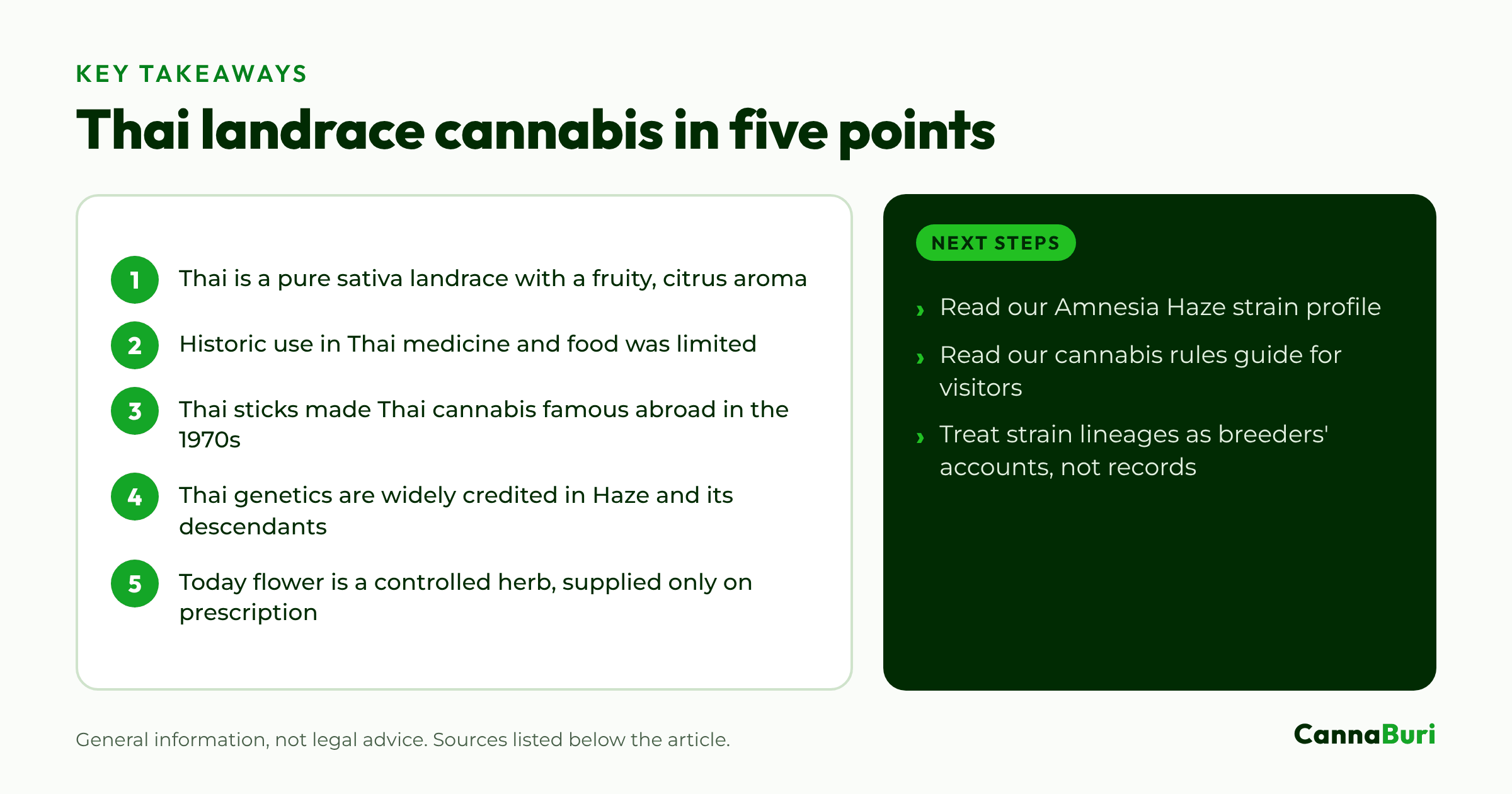
- “Thai” is a pure sativa landrace native to Thailand, with a fruity, citrus aroma.
- Cannabis appears in a Thai traditional medicine text from King Narai’s reign, but historic use was limited.
- Thai sticks became famous abroad in the Vietnam War era, long after Thailand’s first cannabis ban.
- Thai genetics are widely credited in Haze and the many strains descended from it.
- Since June 2025, cannabis flower has been a controlled herb, supplied only on prescription.
What is Thai landrace cannabis?
Leafly describes “Thai” as a pure sativa landrace that grows natively in Thailand. In plain terms, it is a traditional local variety rather than a modern hybrid bred by a seed company. Leafly notes a fruity, citrus aroma and a long growing cycle with slow flowering, which makes it hard to grow outside the tropics.
The word itself has a long trail. The Thai word for cannabis, กัญชา (gancha), is one of many words across Asia and the Caribbean that derive from the Hindi gāñjā, and Wikipedia notes linguistic evidence that the plant reached Thailand from India.
Cannabis in Thai history
Across Southeast Asia, cannabis has been recorded as a kitchen ingredient, a medicine and a source of fibre. In Thailand specifically:
- Traditional medicine texts: cannabis appears in formulas recorded in a Thai traditional medicine text from the reign of King Narai (1656 to 1688).
- Food: Cannavigia names boat noodle soup, with the root infused in the broth, as the most widely cited culinary example.
- Textiles: Hmong textile makers in the region have traditionally grown hemp in small family plots and woven it into cloth for indigo batik skirts and baby carriers.
It is easy to overstate this history. A 2019 review in the Journal of Thai Traditional and Alternative Medicine by Vichai Chokevivat found that cannabis was used in some medicines and foods, but only to a limited extent. It found no evidence of cannabis in rituals, and noted that Thai society historically viewed recreational use negatively.
From prohibition to Thai sticks
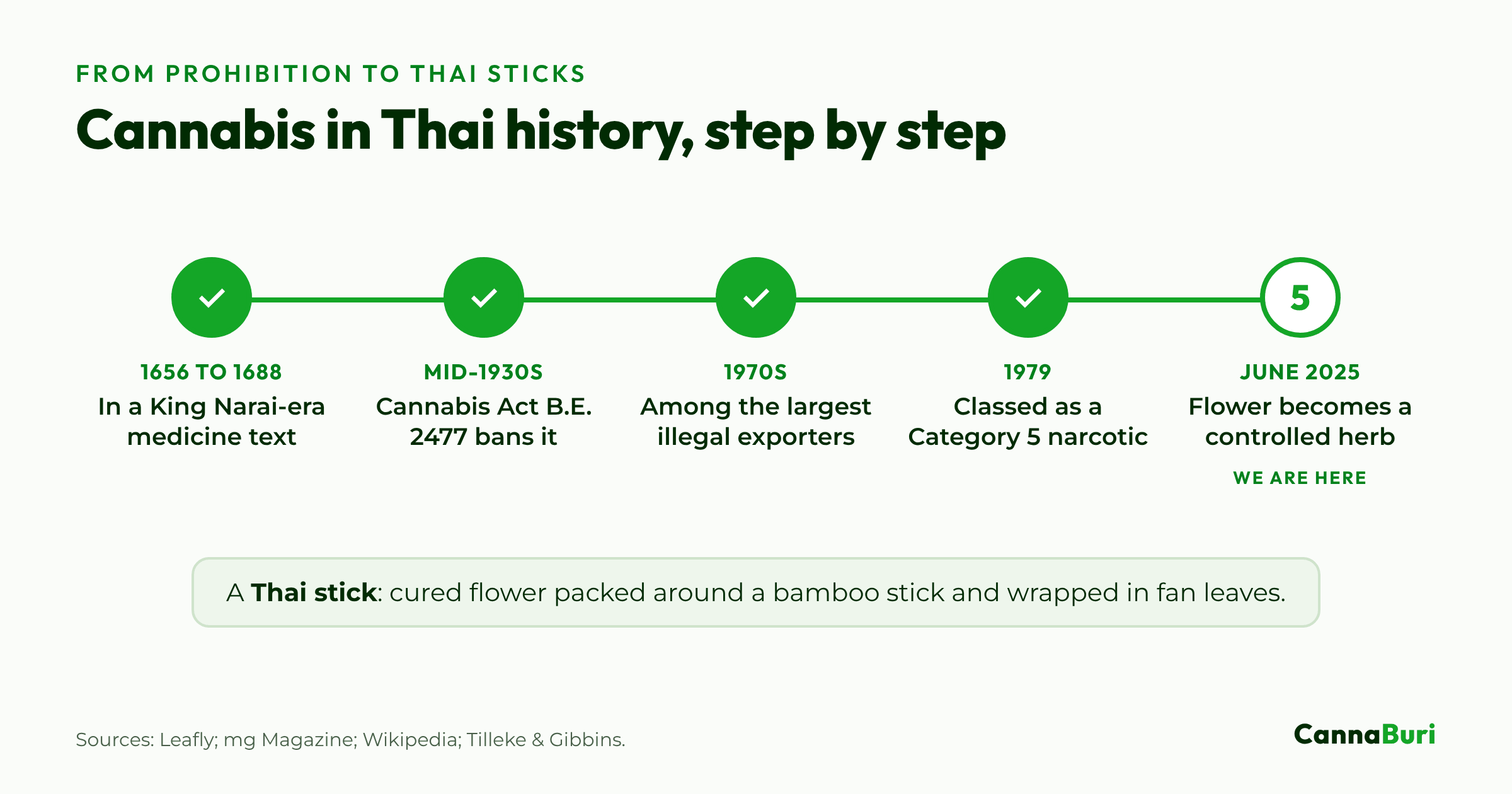
Thailand’s first cannabis law, the Cannabis Act B.E. 2477, was passed in the mid-1930s and prohibited cultivation, possession, sale and use. The Narcotics Act B.E. 2522 of 1979 later classed cannabis as a Category 5 narcotic.
Prohibition did not stop Thai cannabis from becoming famous abroad. According to Leafly, Thai sticks originated in north-eastern Thailand: cured flower packed around a bamboo stick, wrapped in fan leaves and tied with hemp string. Nobody knows exactly when the method began.
During the Vietnam War era, the United States had military bases in Thailand, and soldiers and travellers brought Thai sticks home. mg Magazine reports that Thailand became one of the world’s largest illegal cannabis exporters for most of the 1970s and early 1980s. Leafly notes that the supply had largely dried up by the 1980s.
How Thai genetics shaped modern strains
Seeds from that era found their way into breeding programmes, especially in the United States. Leafly credits Thai genetics with contributing to several well-known strains, including Voodoo, Juicy Fruit and the original Haze.
Haze is the most important link. Leafly says Haze first appeared in Santa Cruz, California, in the 1960s, drawing on genetics from Colombia, Mexico, Thailand and South India. Haze in turn became a parent of many later strains. Amsterdam’s Amnesia Haze is built on Haze genetics, and Blue Dream, one of the parents of a strain called Green Dream, is listed as a cross of Blueberry and Haze.
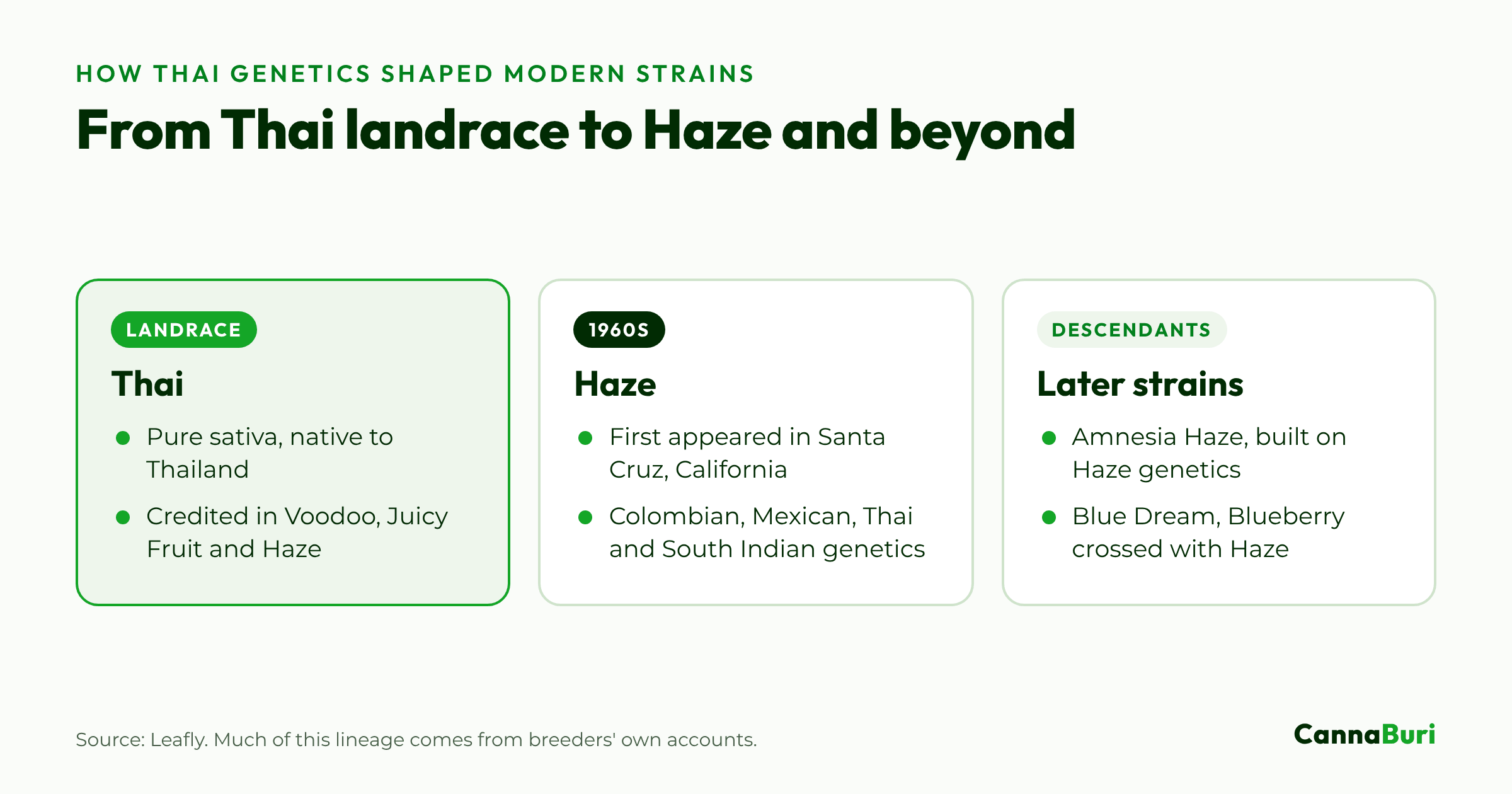
A word of caution: records from the 1960s and 1970s were informal, and much of this lineage comes from breeders’ own accounts. Even strain databases disagree on the details. It is fair to say Thai genetics are widely credited in modern cannabis; precise percentages are not knowable.
Thai cannabis today
The legal picture has changed several times in recent years. Cannabis was removed from the narcotics list in June 2022. Since June 2025, cannabis flower has been a controlled herb, available from licensed shops only with a prescription or medical certificate from a Thai-licensed practitioner. Buyers must be 20 or over, and flower may not be supplied to pregnant or breastfeeding women.
Smoking in public places and on shop premises is not allowed, and cannabis may not be taken out of the country. Cultivation and sale both need licences, and flower sold through licensed channels must come from GACP-certified sites, such as a GACP-certified Thai farm. In September 2026 the cabinet approved a draft cannabis control bill that would limit use to medical purposes; it is now before parliament. See our guide to cannabis rules in Thailand for visitors for the current position.
Key takeaways
If Thai cannabis history interests you, or you have questions about the current rules, you are welcome to visit our store on Pattaya 3rd Road or contact the team. We enjoy talking about the history of the plant in Thailand.
This article is general information, not legal or medical advice.
Sources
- Leafly: Thai strain
- Leafly: What is a Thai stick?
- Leafly: Haze strain
- Leafly: Blue Dream strain
- Wikipedia: Ganja
- Wikipedia: Cannabis in Thailand
- Cannavigia: Cannabis Country Report Thailand, Part 1
- Journal of Thai Traditional and Alternative Medicine: Marijuana in the Thai Way of Life (Chokevivat, 2019)
- Wikipedia: Hmong textile art
- mg Magazine: Thailand’s Cannabis History and Modern Evolution
- Tilleke & Gibbins: Thailand’s New Cannabis Controls Impact Doctors, Dispensaries, and Growers (September 2025)
- The Nation: Thailand strengthens controls on cannabis flower sales and exports (July 2026)
- The Nation: Thai cabinet endorses draft cannabis control bill for medical use (September 2026)
- Thailand Starter Kit: An Expat’s Guide to Cannabis in Thailand (updated July 2026)
