



Cannabis Terpenes: Lab Testing, Batch Variation and Storage
24/10/2026
Hash Quality Explained: Real Hash, Adulteration and Testing
24/10/2026Last updated October 2026.
Cannabis is a plant, and like any plant material it can be spoiled by mould. It can start on the farm, when humid, moist conditions let fungi take hold in the flowers, or after harvest if flower is stored badly.
This guide covers how to recognise mould, why it matters, how to store flower sensibly and why laboratory testing is important, followed by how licensed growers reduce the risk.
At a glance
- Grey mould (bud rot) and powdery mildew are the two best-documented fungal problems on cannabis.
- The risk from mould is low for most people but much higher for those with weakened immune systems.
- Moisture is what lets mould grow, so sealed, dry storage matters in Thailand’s humid climate.
- Not every problem is visible: a CoA with microbial testing shows what the eye cannot.
- For growers, prevention works better than relying on sterilisation after harvest.
What mould on cannabis looks like
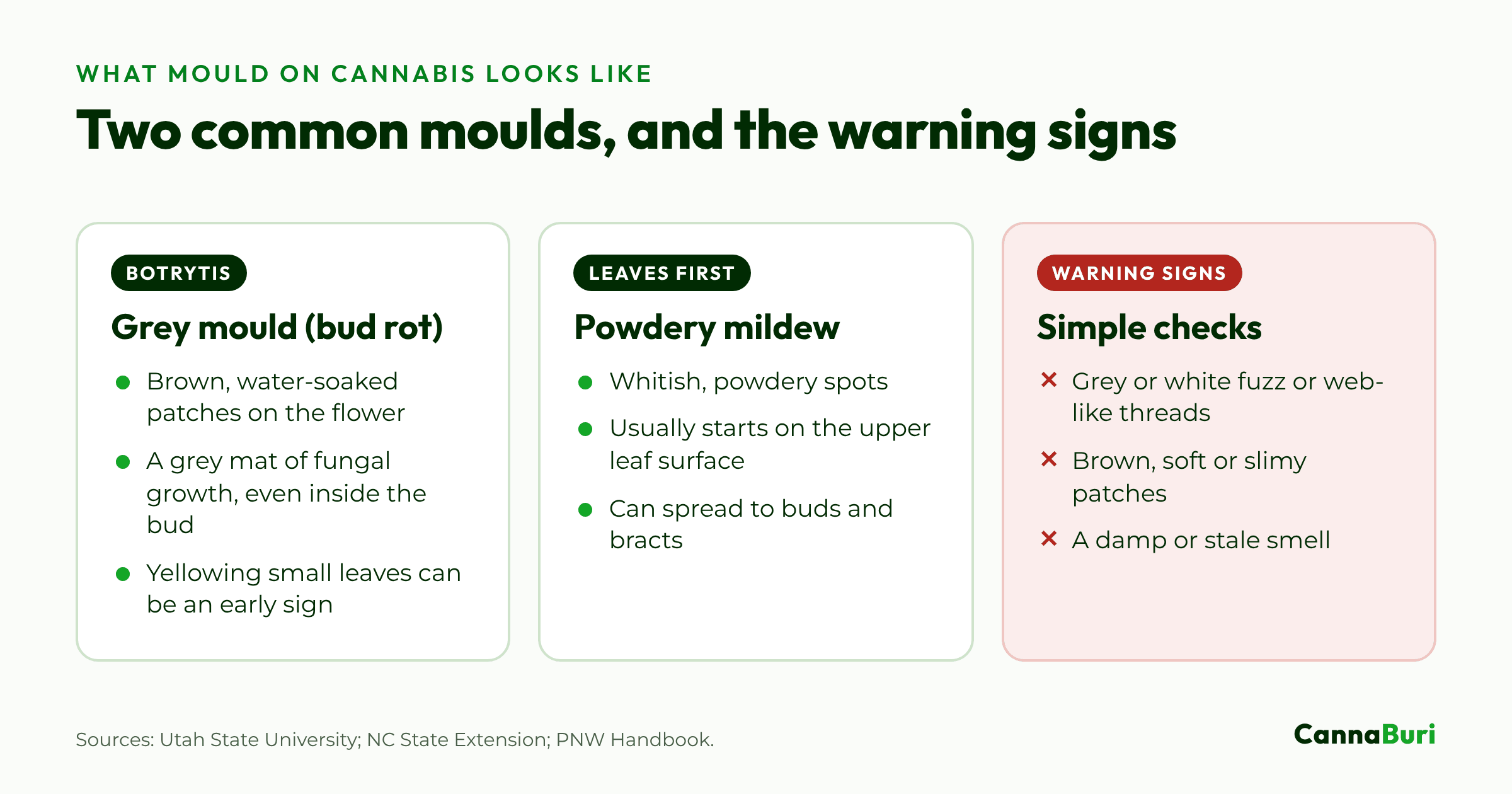
Two fungal problems are especially well documented on cannabis and hemp crops: grey mould and powdery mildew. Both can be spotted by eye once they take hold, which is why a close look is the first check.
Grey mould (bud rot)
Grey mould, caused by Botrytis fungi, is often called bud rot because it attacks the flowers. University extension services in Utah and North Carolina describe it starting as brown, water-soaked patches on the flower that die back, followed by a grey mat of fungal growth around and within the flower cluster. Yellowing of the small leaves around the bud can be an early sign.
Powdery mildew
Powdery mildew appears as whitish, powdery spots, usually starting on the upper surface of leaves. Heavy infections can cover whole leaves and spread to the buds and the small leaves (bracts) around them.
Simple checks as a consumer
- Look closely: healthy flower is often coated in tiny resin glands (trichomes) that look frosty or sparkly. Grey or white fuzz, web-like threads, a dusty coating, or brown, soft or slimy patches are warning signs.
- Look inside: if a bud has been broken open, check the centre too, since grey mould can grow within the flower cluster.
- Use your nose: flower that smells damp or stale rather than fresh deserves a closer look.
- If in doubt, do not use it: ask the shop to check it and to show you the batch’s lab results.
Why mould matters
Mould is not just a cosmetic issue. A 2022 study in the journal PLOS ONE notes that fungi such as Penicillium, Cladosporium, Botrytis and Aspergillus have been found in cannabis from licensed producers, and that inhaling contaminated cannabis can lead to serious fungal infections.
The same paper points out that Aspergillus spores are everywhere and healthy people breathe them in daily without problems; the people most at risk are those with weakened immune systems. Researchers at McGill University, reported in February 2026, made a similar point: the risk is low for the general population but much higher for immunocompromised people, partly because smoking may carry spores or toxins straight into the lungs. Utah State University also advises avoiding breathing in spores from mouldy plants because they can cause allergic reactions.
If you have a health condition or a weakened immune system, talk to a Thai-licensed medical practitioner before using any cannabis product.
Storing flower to avoid mould
Moisture is what allows mould to grow. As one industry report puts it, mould spores can develop quickly when there is enough moisture, but not when flower is dry enough. Thailand’s humid climate makes this especially relevant.
- Keep it sealed: store flower in an airtight container so it does not absorb moisture from humid air.
- Keep it out of damp places: bathrooms, kitchens and spots near air-conditioner drips are poor choices.
- Do not add moisture: avoid putting anything damp in the container with your flower.
- Humidity packs: some people use two-way humidity control packs designed for this purpose, which aim to hold a stable level of humidity inside the container.
- Keep it away from children and pets: the US Centers for Disease Control and Prevention (CDC) warns that children who consume THC products can become very sick.

For the legal side of buying and carrying cannabis, see our guide to Thailand’s cannabis rules.
Why GACP and a CoA with microbial testing matter
You cannot see every problem with the naked eye, which is why laboratory testing matters. A Certificate of Analysis (CoA) is a lab report on a specific batch. Guidance from the New Jersey Cannabis Regulatory Commission shows what a full CoA can cover: cannabinoid content, microbial tests (for example for Aspergillus and other harmful microbes), mycotoxins (toxins produced by moulds), heavy metals, pesticides, and for flower, moisture content and water activity. That guidance says each safety test should show a pass, and the batch number lets you match the report to the product.
In Thailand, flower supplied to licensed shops must come from farms certified under Good Agricultural and Collection Practices (GACP). Inspectors from the Department of Thai Traditional and Alternative Medicine review soil, water, pesticide use, worker hygiene and post-harvest handling, all of which affect the risk of contamination.
When you visit a licensed shop, it is reasonable to ask to see the CoA for the batch, and to check the microbial section in particular. Our article on what GACP and CoA mean walks through how to read one.
Prevention for licensed growers
Cultivating cannabis in Thailand requires a licence, and in July 2026 the Ministry of Public Health ordered stricter inspections of licensed cultivation sites nationwide. For licensed growers, extension research on hemp points firmly towards prevention. Utah State University says there is no fix once bud rot is established, so prevention is key, and notes that no fungicides are currently labelled for it in the United States.
- Spacing and airflow: proper spacing improves air movement between plants and reduces the risk of grey mould.
- Humidity control: both Utah State and NC State advise keeping greenhouse relative humidity below 50% where grey mould is a risk.
- Avoid damaging buds: Botrytis enters through wounds or dying tissue.
- Remove infected material early: take out affected plants or leaves promptly, but not while plants are wet, to avoid spreading spores.
- Clean tools and equipment: disinfect tools and growing spaces regularly.
- Balanced feeding: over-fertilising, especially with nitrogen, produces soft growth that is more susceptible to disease.
- Separate crops: keep young plants away from older, infected plants to stop powdery mildew building up.
- Dry with good airflow: ensure air moves well around plant material while it dries.
The McGill researchers reached a similar conclusion from the other end. They found that sterilised flower could still contain fungal spores and toxin residues, and argued that preventing contamination during cultivation and processing works better than relying on sterilisation after harvest.
Key takeaways

If you would like to see how the flower in our store is tested, or have questions about reading a CoA, you are welcome to visit CannaBuri on Pattaya 3rd Road or contact the team.
This article is general information, not legal or medical advice.
Sources
- Utah State University Extension: Hemp Bud Rot
- NC State Extension: Gray Mold of Industrial Hemp
- Pacific Northwest Plant Disease Management Handbook: Hemp (Cannabis sativa) Powdery Mildew
- PLOS ONE (2022): Use of X-ray irradiation for inactivation of Aspergillus in cannabis flower
- The Analytical Scientist: Why Clean Cannabis May Not Be Clean
- Cannabis Industry Journal: Preventing Yeast and Mold with Two-Way Humidity Control
- New Jersey Cannabis Regulatory Commission: How to Read a COA
- Tilleke & Gibbins: Thailand’s New Cannabis Controls Impact Doctors, Dispensaries and Growers
- CDC: Cannabis Health Effects
- Khaosod English: Health Ministry tightens cannabis farm inspections nationwide
