



Cannabis in Culture: Language, Music, Art and Thai History
24/10/2026
Mould on Cannabis: How to Spot It and Why Testing Matters
24/10/2026Last updated October 2026.
Two jars of the same strain can smell surprisingly different: one bright and citrusy, the other flatter and more earthy. The reasons usually come down to terpenes, how much the plant made in the first place and how much survived drying and storage. This article explains how terpenes are measured on a lab report, why aroma varies between batches and what research tells us about storage; it is about aroma and quality only, not effects or health.
At a glance
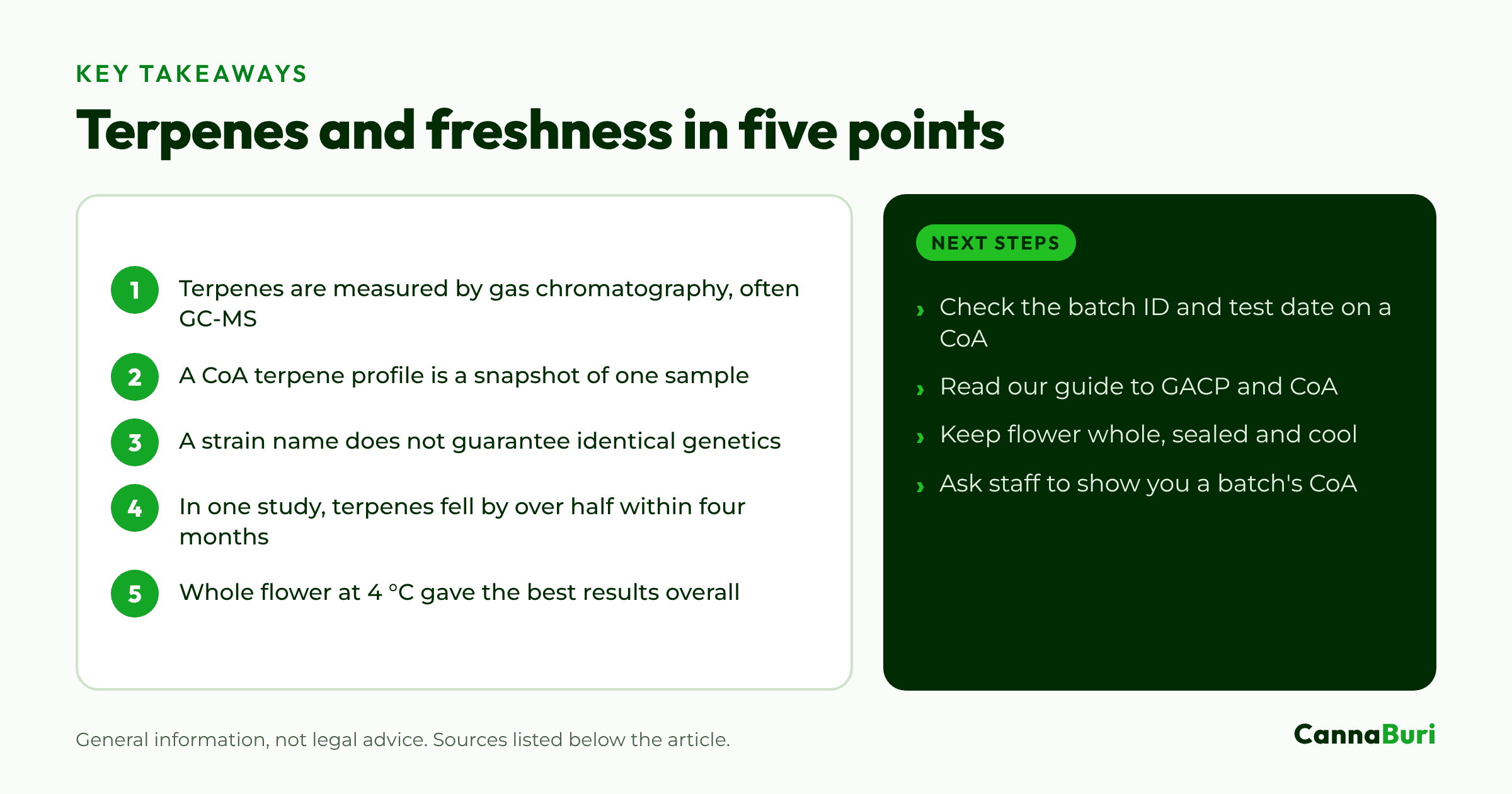
- Terpenes are usually measured by gas chromatography and often reported on a CoA as a percentage by weight.
- A terpene profile is a snapshot of one sample on its test date, not a promise of how it smells months later.
- A strain name does not guarantee identical genetics, so aroma can vary between batches.
- In a one-year storage study, average terpene levels fell by more than half within four months.
- The study’s authors found whole flower stored at 4 °C gave the most favourable results overall.
How terpenes are measured
A certificate of analysis, or CoA, is a set of lab test results for one batch of product. Cannabinoids such as THC and CBD are the headline figures, but many CoAs also include a terpene profile.
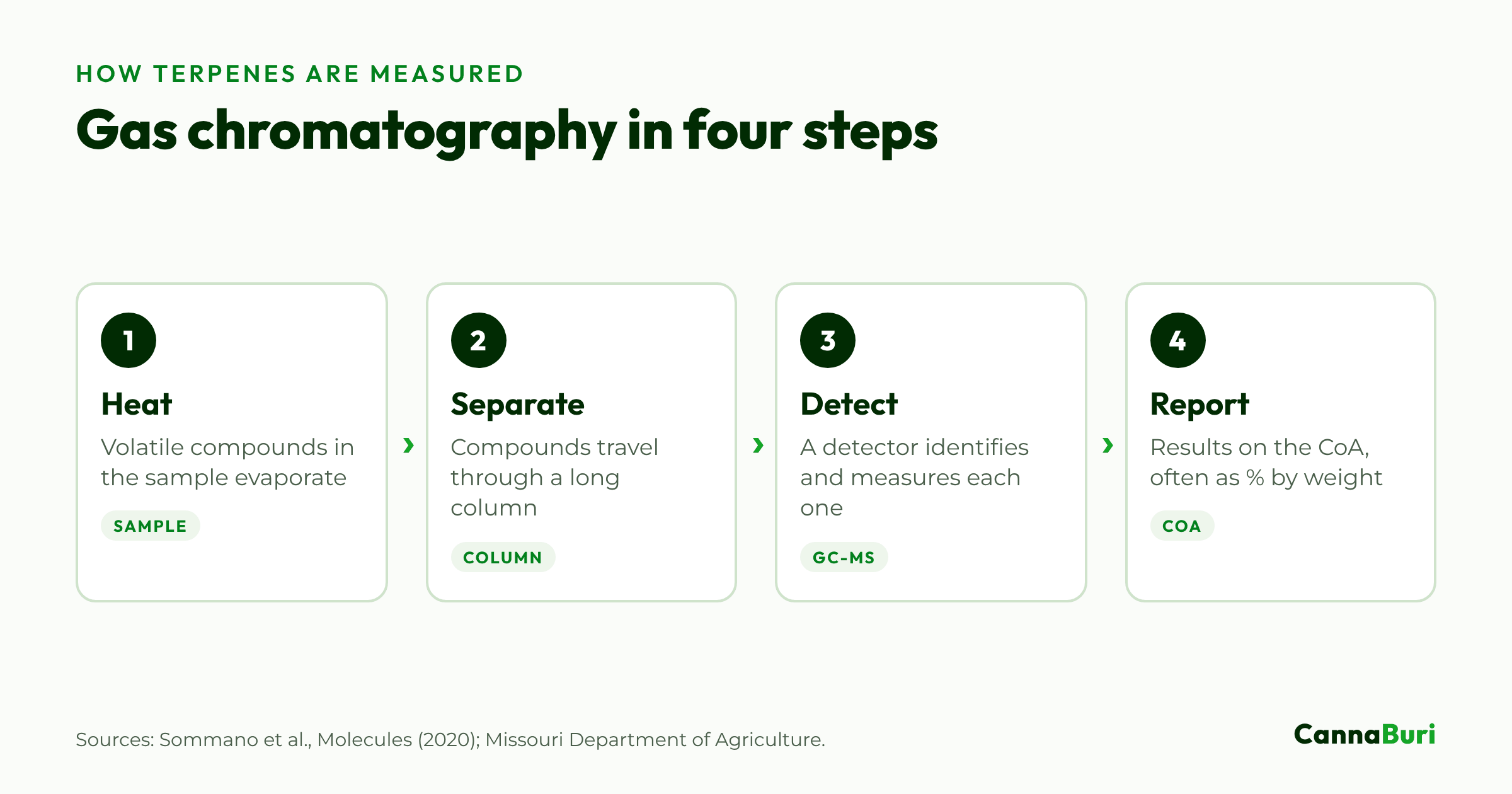
Terpenes are usually measured with gas chromatography. The sample is heated so its volatile compounds evaporate, the compounds are separated as they travel through a long column, and a detector identifies and measures each one. A peer-reviewed review of cannabis terpenes describes gas chromatography with mass spectrometry (GC-MS) as the standard way to analyse terpene extracts from flower.
Reading the terpene section of a CoA
Terpene results are often shown as a percentage by weight, sometimes alongside milligrams per gram. You will normally see a list of compound names, a result for each, and a few technical terms:
- LOQ and LOD: the limit of quantitation and the limit of detection describe the lowest amount the lab can reliably measure and report.
- ND and <LOQ: ND means not detected. <LOQ means the compound may be present but below the level the lab can measure accurately.
- Total terpenes: the sum of the individual terpenes the lab tested for. A lab can only report the compounds on its test list.
- Measurement uncertainty: where shown, this is the lab’s margin of error, so a result is really a range rather than an exact figure.
Always check that the batch or sample ID on the CoA matches the product in front of you, and look at the test date. A terpene profile is a snapshot of the sample on the day it was tested, not a promise of how it smells months later. Our guide to what GACP and CoA mean covers the rest of the report.
Why aroma varies between batches
Genetics and strain names
The terpenes a plant can make depend first on its genetics. The trouble is that a strain name does not guarantee identical genetics. A genetic study of 122 samples sold under 30 strain names in three US states found that most strains contained at least one genetic outlier, meaning a sample that did not match the others sharing its name.
A much larger study of US lab data found that some strain names were chemically consistent across producers while others varied widely. In other words, the name on the jar is a starting point, not a guarantee. Our Indica vs Sativa vs Hybrid guide looks at the limits of labels in more detail.
Growing, harvest and handling
Even with identical genetics, terpene content shifts. The review mentioned above describes terpene composition as a seasonal variable that also depends on environmental conditions, the part of the plant sampled and its maturity. Light, temperature, harvest timing and the skill of the grower all leave a mark, which is one reason GACP-certified farms must keep detailed records of each crop.
Terpenes are also volatile, so drying, trimming, packing and storage all affect what reaches the shelf. Grinding speeds up losses because it exposes more surface area.
How storage affects terpenes
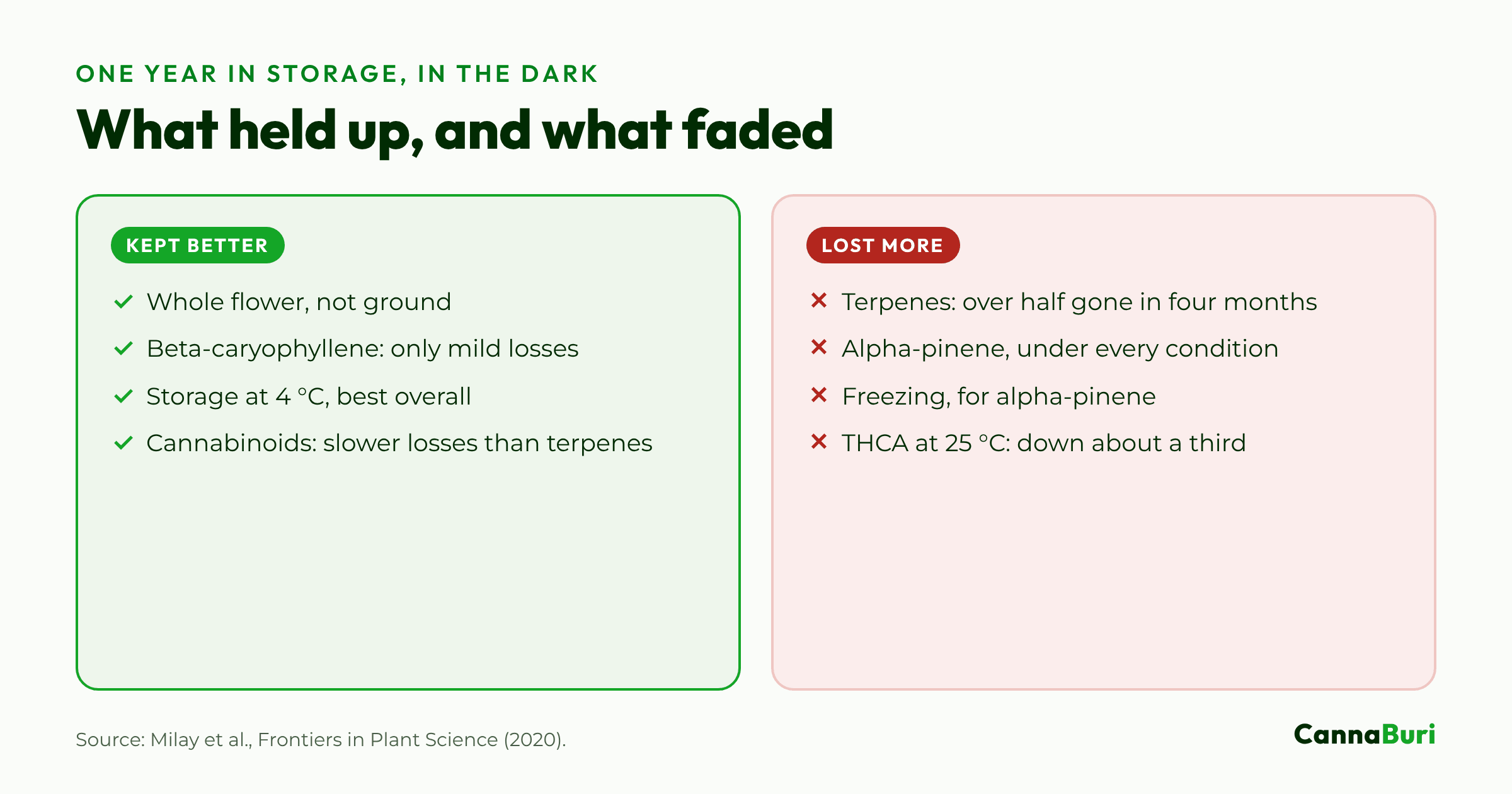
A 2020 study published in Frontiers in Plant Science stored dried cannabis flower in the dark for a year at four temperatures: 25 °C, 4 °C, minus 30 °C and minus 80 °C. The findings are useful for anyone who wants to understand why flower changes over time.
- Terpenes faded faster than cannabinoids: average terpene levels fell by more than half within four months.
- Some terpenes are more fragile than others: alpha-pinene dropped significantly under every condition, while beta-caryophyllene showed only mild losses.
- Whole flower kept better than ground flower: ground samples generally had lower terpene levels and more breakdown products.
- Warmth changed the cannabinoids: at 25 °C, THCA in THC-rich flower fell by about a third over the year as it converted to THC, and CBN slowly increased.
- Colder was not always better: freezing was especially unfavourable for alpha-pinene. The authors concluded that whole flower stored at 4 °C gave the most favourable results overall.
Air matters too. Limonene oxidises easily in moist air, and myrcene is unstable in air, which is one reason sealed packaging is important.
Practical storage pointers
Putting the findings into practice:
- Keep it whole: leave flower whole until you need it.
- Keep it sealed: use an airtight container and open it as little as possible.
- Keep it cool: store it away from heat sources, which matters in a warm climate like Thailand’s.
- Keep it dark: the study kept every sample in the dark, so light was not tested. An opaque container is a sensible precaution all the same.
A reminder on the rules: in Thailand, cannabis flower can now only be supplied by licensed outlets against a valid prescription, and it should never be packed in luggage for travel abroad.
Key takeaways
If you would like to talk any of this through, you are welcome to visit our store on Pattaya 3rd Road or contact the CannaBuri team with your questions. We are happy to show you the CoA for a batch and explain what each line means.
This article is general information, not legal or medical advice.
Sources
- Missouri Department of Agriculture: Certificate of Analysis Guide
- MDPI Molecules: The Cannabis Terpenes (Sommano et al., 2020)
- Frontiers in Plant Science: Metabolic profiling of cannabis secondary metabolites for evaluation of optimal postharvest storage conditions (Milay et al., 2020)
- PLOS ONE: The phytochemical diversity of commercial Cannabis in the United States (Smith et al., 2022)
- Journal of Cannabis Research: Genetic tools weed out misconceptions of strain reliability in Cannabis sativa (Schwabe and McGlaughlin, 2019)
- Wikipedia: Limonene
- Wikipedia: Myrcene
- Tilleke & Gibbins: Thailand’s cannabis reset, dispensaries to clinics (January 2026)
- Tilleke & Gibbins: Thailand’s new cannabis controls impact doctors, dispensaries and growers (September 2025)
- Khaosod English: Thai police warn travellers over cannabis smuggling risk (July 2026)
