

Hemp vs Cannabis in Thailand: What’s the Difference?
27/10/2026Last updated October 2026. This article is general information, not legal or medical advice.
Thailand’s cannabis rules are on the move again. On 22 September 2026, the Thai cabinet approved a draft Cannabis Control Bill that would limit cannabis to medical use and write that limit into an Act of Parliament. A month later, the government also announced plans for tougher penalties and stricter export checks.
If you live in Pattaya or are visiting, you have probably seen the headlines. This guide explains, in plain terms, what the draft bill says, what it would mean for licensed shops, and, just as important, what has not changed yet.
Where things stand in October 2026
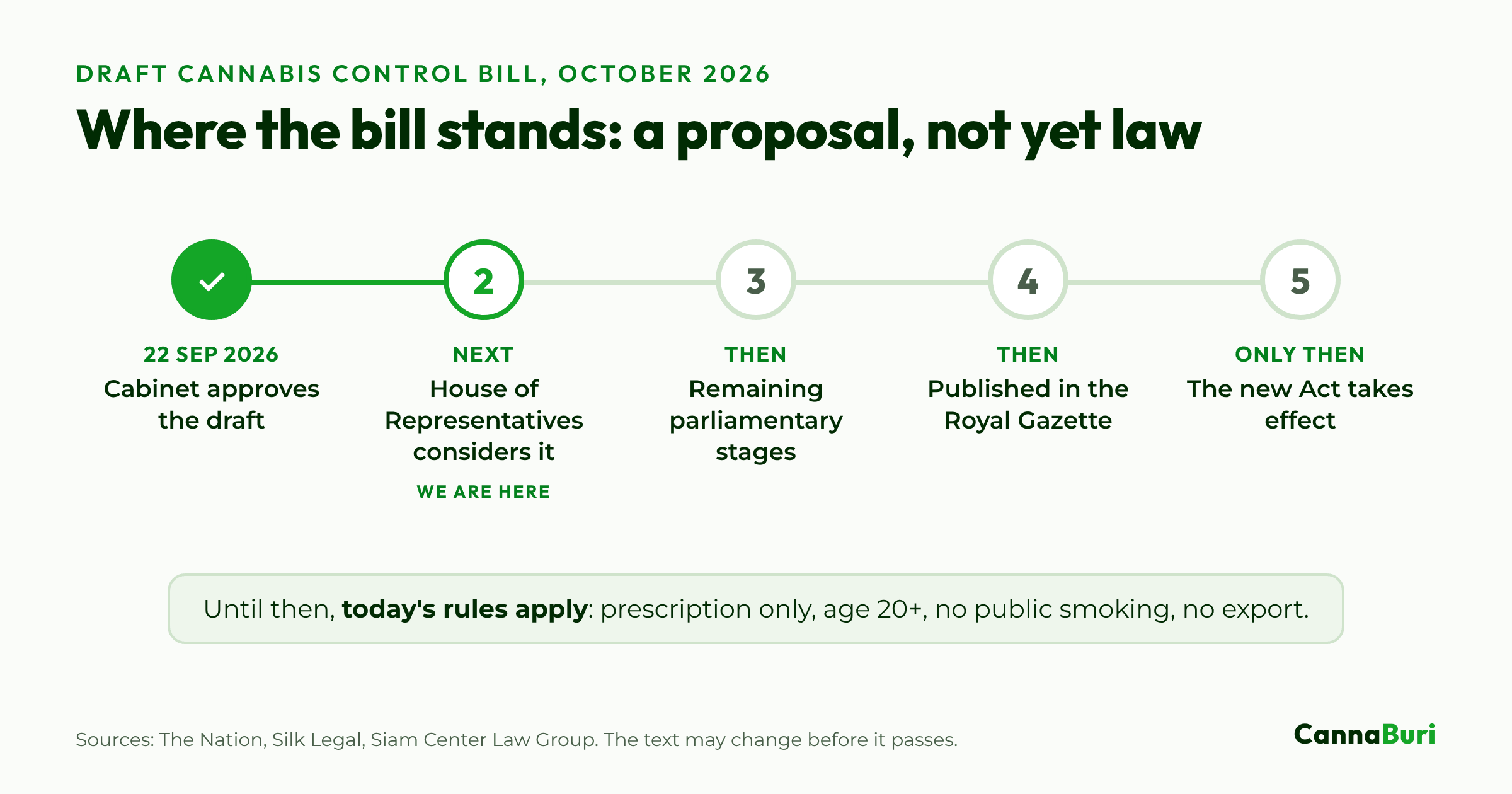
The short version: the bill is a proposal, not law. After cabinet approval, it goes to the House of Representatives, and it must pass every remaining stage of the legislative process and be published in the Royal Gazette before it takes effect. Silk Legal, a Thai law firm, notes that the text may be amended along the way, and that the current regulatory framework continues to apply until then.
One Thai law firm, Siam Center Law Group, also points out that the government’s own published summary of the 22 September cabinet meeting did not list the bill, and suggests treating it as a proposal until the official resolution and bill text can be checked. That is sensible advice for anyone reading the news.
For background on how Thailand got here, see our timeline of Thailand’s cannabis policy from 2019 to 2026.
What the draft Cannabis Control Bill would do
Based on reporting by The Nation, Thai Examiner and Silk Legal, the main points of the draft are as follows.
Medical use only
Cannabis and cannabis extracts would be limited to medical treatment by authorised practitioners and to research. Recreational use would not be permitted. Public Health Minister Pattana Promphat said a prescription would need a document signed by a doctor, in the same way as for medicines. Thai Examiner reports that the bill would not return cannabis to the narcotics list.
Licences across the supply chain
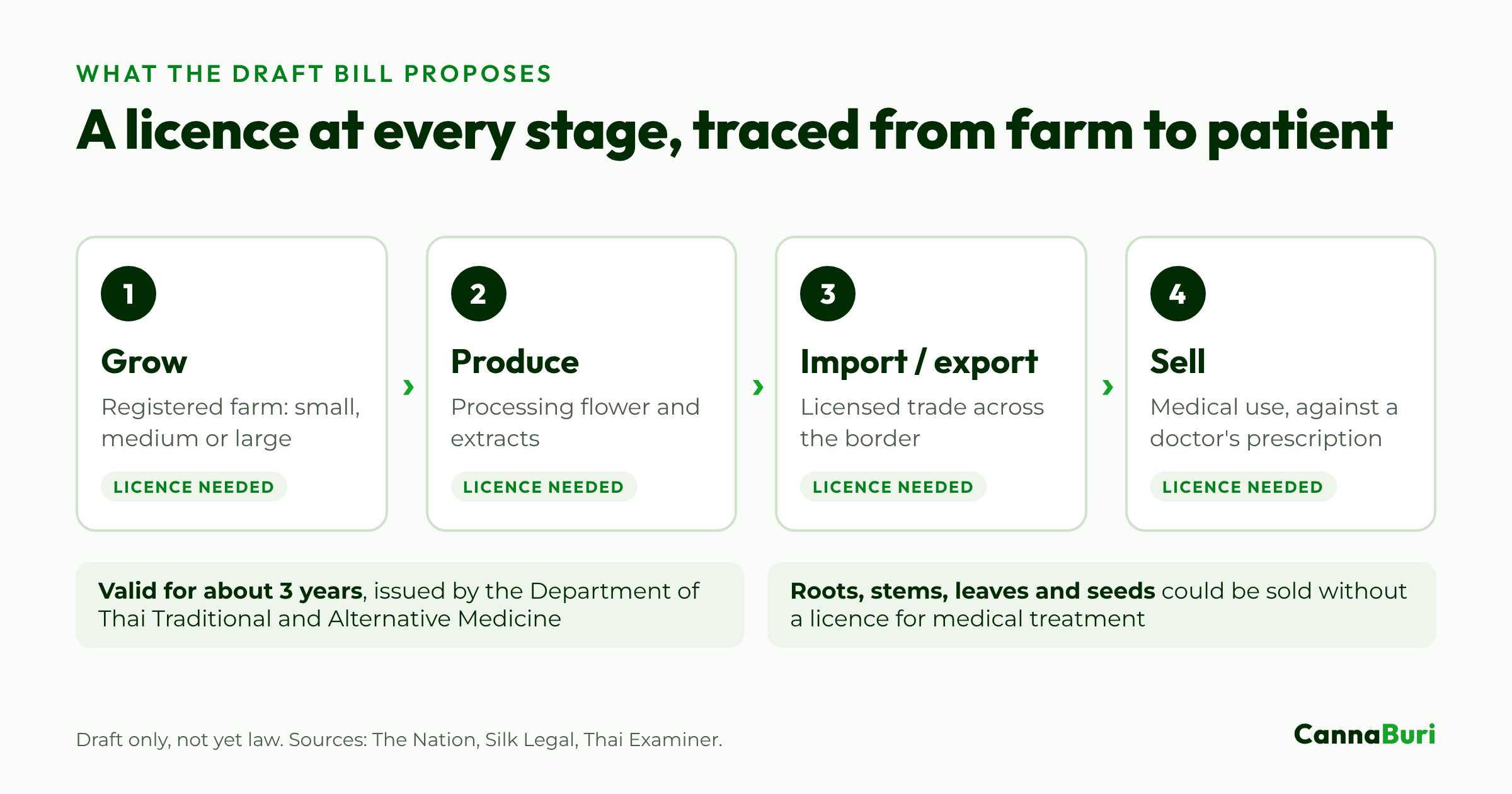
Cultivation, production, import, export and sale of cannabis flower and extracts would each need a licence, generally valid for three years. Silk Legal reports that licences would be issued by the Department of Thai Traditional and Alternative Medicine, and that roots, stems, branches, leaves and seeds could be sold without a licence if intended for medical treatment.
Registered, traceable farms
Cultivation sites would have to register as small, medium or large, so that officials can trace cannabis from the farm, through processing, to the point of sale. The minister said this would help with quality control and make clear how flowers may be used and processed into extracts. If you want to know what traceability looks like in practice today, our guide to GACP certification and Certificates of Analysis explains the paperwork behind each batch.
Age, location and advertising limits
According to Thai Examiner, the draft keeps a ban on sales to anyone under 20 and to pregnant and breastfeeding women. It would also prohibit sales at places such as educational establishments, temples, dormitories, public parks, zoos and amusement parks. Advertising of cannabis flower and resin would be banned, and promotion of smoking equipment restricted.
Clearer and tougher penalties
The bill describes its penalties as clearer and heavier than under the current framework. Unlicensed production, import, export or sale could bring criminal penalties, while unlicensed users would face fines only, according to Silk Legal. Forged prescriptions could lead to action against businesses, individuals and practitioners. None of the sources we read gives specific fine amounts or prison terms for the new offences, so treat any figures you see online with caution until the final text is published.
What it would mean for cannabis shops
Existing shop licences run for three years and expire in stages. Thai Examiner reports roughly 5,000 to 6,000 expiring in 2026, 4,000 to 5,000 in 2027 and about 1,000 in 2028. Shops could keep trading under their current licence until it expires.
At renewal, shops that are not medical facilities would need to meet the new law’s requirements. In practice, that means converting into a recognised medical facility with a qualified practitioner on site and supplying cannabis only against a prescription. The minister estimated that more than half of shops would need to make this change.
Enforcement is also stepping up. The Ministry of Public Health plans inspection teams, especially in tourist centres and major cities. An online map lets officials and medical cannabis users check whether a shop is registered: around 10,000 locations have been recorded, and a shop that is not on the map is presumed not to be legally registered.
Separate moves: penalties and export checks
On 22 October 2026, Bernama reported a statement from Prime Minister Anutin Charnvirakul, following a meeting of the Office of the Narcotics Control Board. The government plans amendments to the Narcotics Act with tighter cannabis rules and tougher penalties, while keeping a clear line between medical and recreational use. Inspections of licensed venues will continue, with legal action, including possible licence revocation, for operators who breach their conditions.
The Customs Department will also step up inspections, intelligence gathering and random checks on exports. Cannabis stems, leaves and flower buds must comply with Thai law, while CBD extracts may be exported subject to licensing and Thai FDA rules.
What has not changed: the rules in force today
While the bill works its way through Parliament, the current rules still apply. These are the ones most relevant to residents and visitors:
- Prescription required. Since late June 2025, cannabis flower has been a controlled herb, and shops may not sell it without a prescription. Supply is capped at an amount for up to 30 days. Lawful supply uses the official controlled-herb prescription form, known as Phor Thor 33 (PT33).
- Age 20 and over. Official Thai guidance limits possession and use to people aged 20 and over, and licensed shops may not sell to anyone under 20.
- No smoking in public. Smoking cannabis in public places is not permitted, and smoke or odour that bothers others can be treated as a nuisance under the Public Health Act.
- No export. A Thai purchase or prescription does not allow you to carry cannabis through an airport or across a border. Our guide to cannabis and travel in Thailand covers this in more detail.
For a fuller overview written for visitors, see cannabis rules in Thailand for visitors. If you have any health question, please speak to a Thai-licensed medical practitioner.
What happens next
The next step is consideration by the House of Representatives, followed by the remaining parliamentary stages. Earlier drafts have stalled before, and the text could change. Until a final Act is published in the Royal Gazette, the current ministerial regulations remain the law. We will update this article as the bill progresses.
Questions?
If you have questions about how the current rules work, you are welcome to visit us on Pattaya 3rd Road or contact our staff, who are happy to explain.
Sources
- The Nation: Thai cabinet endorses draft cannabis control bill for medical use (23 September 2026)
- Silk Legal: Thailand’s Cabinet approves a medical-only Cannabis Control Bill (5 October 2026)
- Thai Examiner: Latest cannabis bill agreed by cabinet (23 September 2026)
- Bernama: Thailand to tighten cannabis controls, propose tougher penalties (22 October 2026)
- Siam Center Law Group: Thailand cannabis laws in 2026 (13 October 2026)
- Associated Press: Thailand starts banning the sale of cannabis without a prescription (27 June 2025)
- Khaosod English: Thailand tightens controls on medical cannabis sales (16 May 2026)
- Royal Thai Government: Cannabis Handbook for foreigners
