

Cannabis and Travel in Thailand: Flights, Borders and Hotels
24/10/2026
Cannabis in Culture: Language, Music, Art and Thai History
24/10/2026Last updated October 2026.
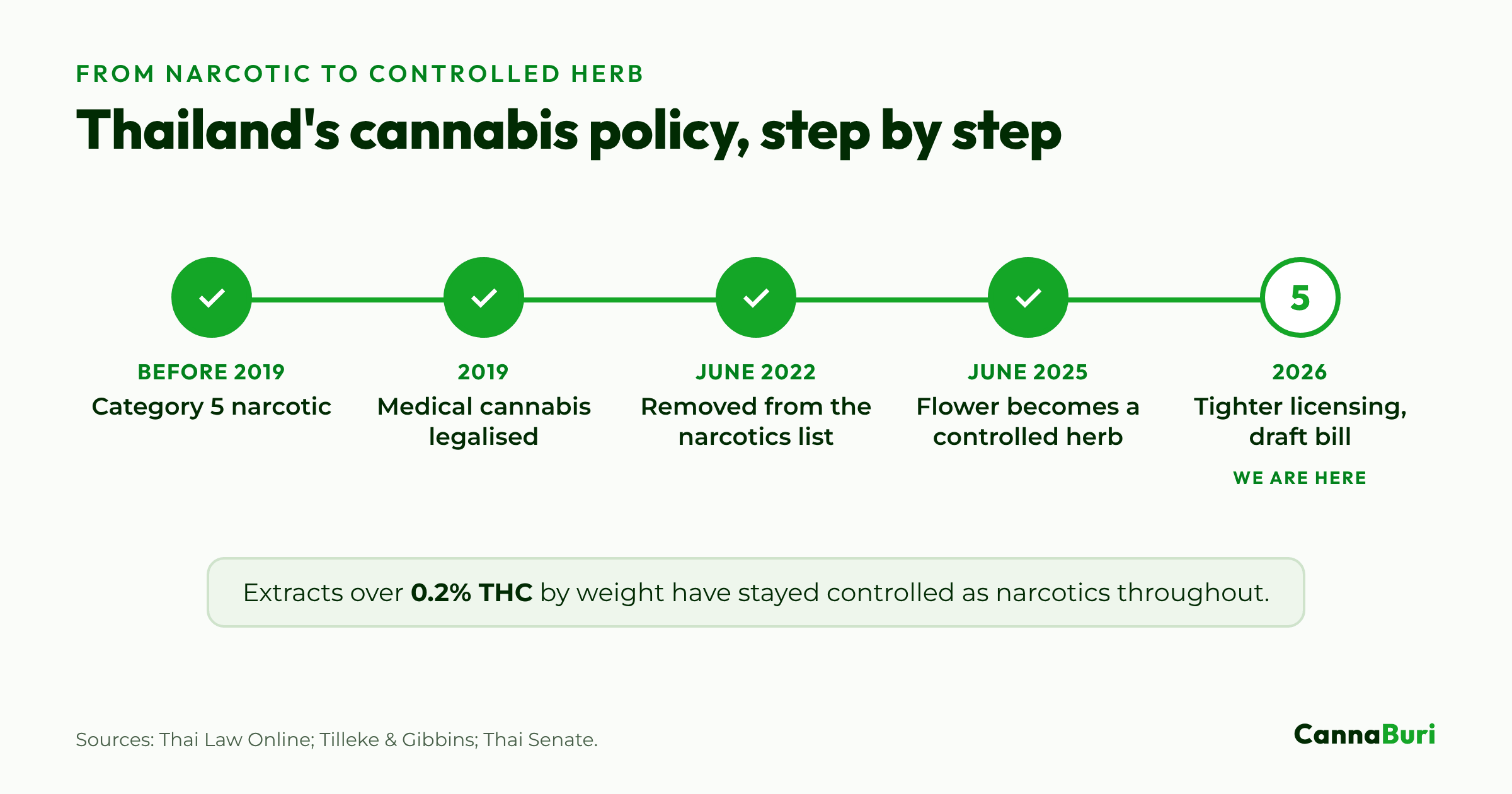
Thailand’s cannabis rules have changed more in the past seven years than in the previous forty. In that time cannabis has gone from a criminal narcotic, to a legal medicine, to an almost unregulated product, and back to a tightly licensed controlled herb.
This guide sets out the facts in order: the main policy changes from 2019 to late 2026, how the licensed system works today, and what may change next.
At a glance
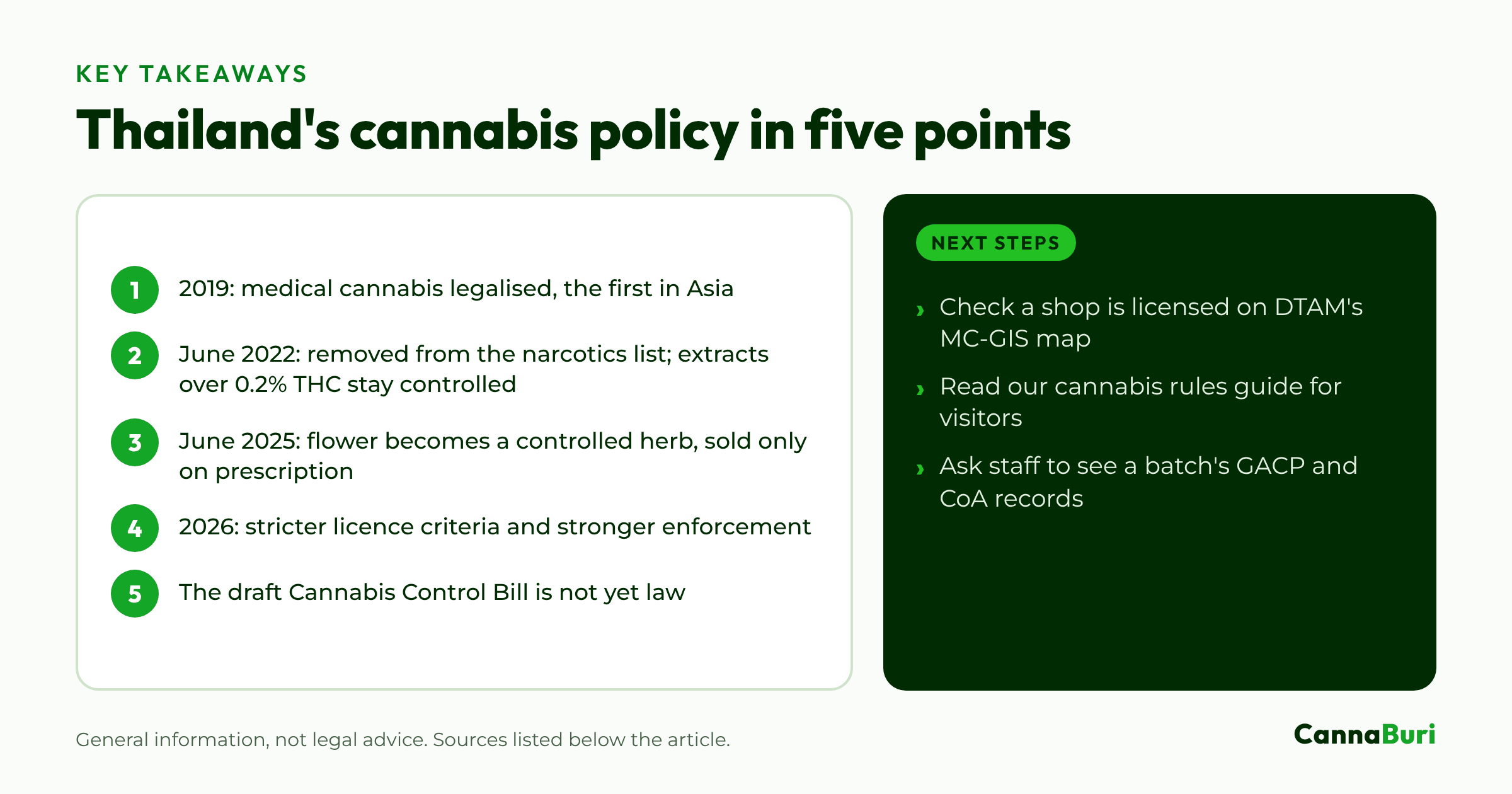
- 2019: Thailand became the first country in Asia to legalise medical cannabis.
- June 2022: cannabis was removed from the narcotics list, and shops spread quickly.
- June 2025: cannabis flower became a controlled herb, sold only against a prescription.
- 2026: licensing has tightened, enforcement has stepped up, and a draft Cannabis Control Bill is before Parliament.
From narcotic to controlled herb: 1979 to 2025
Before 2019: a Category 5 narcotic
Under the Narcotics Act B.E. 2522 (1979), cannabis was classed as a Category 5 narcotic. Growing, selling and possessing it were criminal offences, and that remained the position for four decades.
2019: medical cannabis is legalised
The Narcotics Act (No. 7) B.E. 2562 was passed in December 2018 and took effect in 2019, making Thailand the first country in Asia to legalise medical cannabis. Cannabis stayed on the narcotics list, but medical use and research became possible under a licensing system.
June 2022: removal from the narcotics list
On 9 June 2022, a Ministry of Public Health notification removed cannabis from the Category 5 narcotics list. Extracts containing more than 0.2% THC by weight remained controlled as narcotics, and they still are today. A separate notification made cannabis a controlled herb, and cannabis smoke or odour that disturbs others was declared a nuisance under the Public Health Act. Dispensaries then spread rapidly, particularly in Bangkok and tourist areas.
June 2025: stricter rules for cannabis flower
A new Ministry of Public Health notification on controlled herbs came into force on 26 June 2025, replacing the 2022 version. Its main points for cannabis flower are:
- Licences: anyone who researches, exports, sells or processes cannabis flower commercially needs a licence under Section 46 of the Thai Traditional Medicine Act.
- Prescriptions: licensed shops may sell to the public only against a prescription from a listed Thai-licensed practitioner, for no more than 30 days’ supply.
- Certified farms: flower that is sold or exported must come from a cultivation site certified to Good Agricultural and Collection Practices (GACP) by the Department of Thai Traditional and Alternative Medicine (DTAM).
- Banned: selling for smoking on the premises, vending machines, electronic sales channels and advertising.
- Restricted places: no sales at temples, dormitories, public parks, zoos or amusement parks.
2026: tighter licensing and stronger enforcement
Four changes in 2026 shape how licensed shops operate today.
- March 2026: a new regulation covering cannabis extracts was published, taking effect in April.
- 30 April 2026: Ministerial Regulation (No. 2) B.E. 2569 tightened the criteria for licences to sell, process or export cannabis flower. Applicants must own or lawfully occupy their premises, have suitable storage, and hold a qualifying status such as a medical facility, pharmacy, herbal product business or certified folk healer, or be a cultivator selling to licensed shops. At least one DTAM-trained staff member must be present during opening hours, and premises need an effective odour and smoke elimination system. Existing licences continue until they expire; renewals must meet the new criteria.
- June 2026: DTAM published penalty guidelines for licensed shops, ranging from 30-day suspensions for record-keeping failures to revocation for selling online or allowing smoking on the premises. From 17 June, the Customs Department began fining people caught trying to take cannabis out of Thailand 30,000 baht per kilogram.
- 22 September 2026: the Cabinet approved a draft Cannabis Control Bill (see below).
How the licensed system works today
Licences
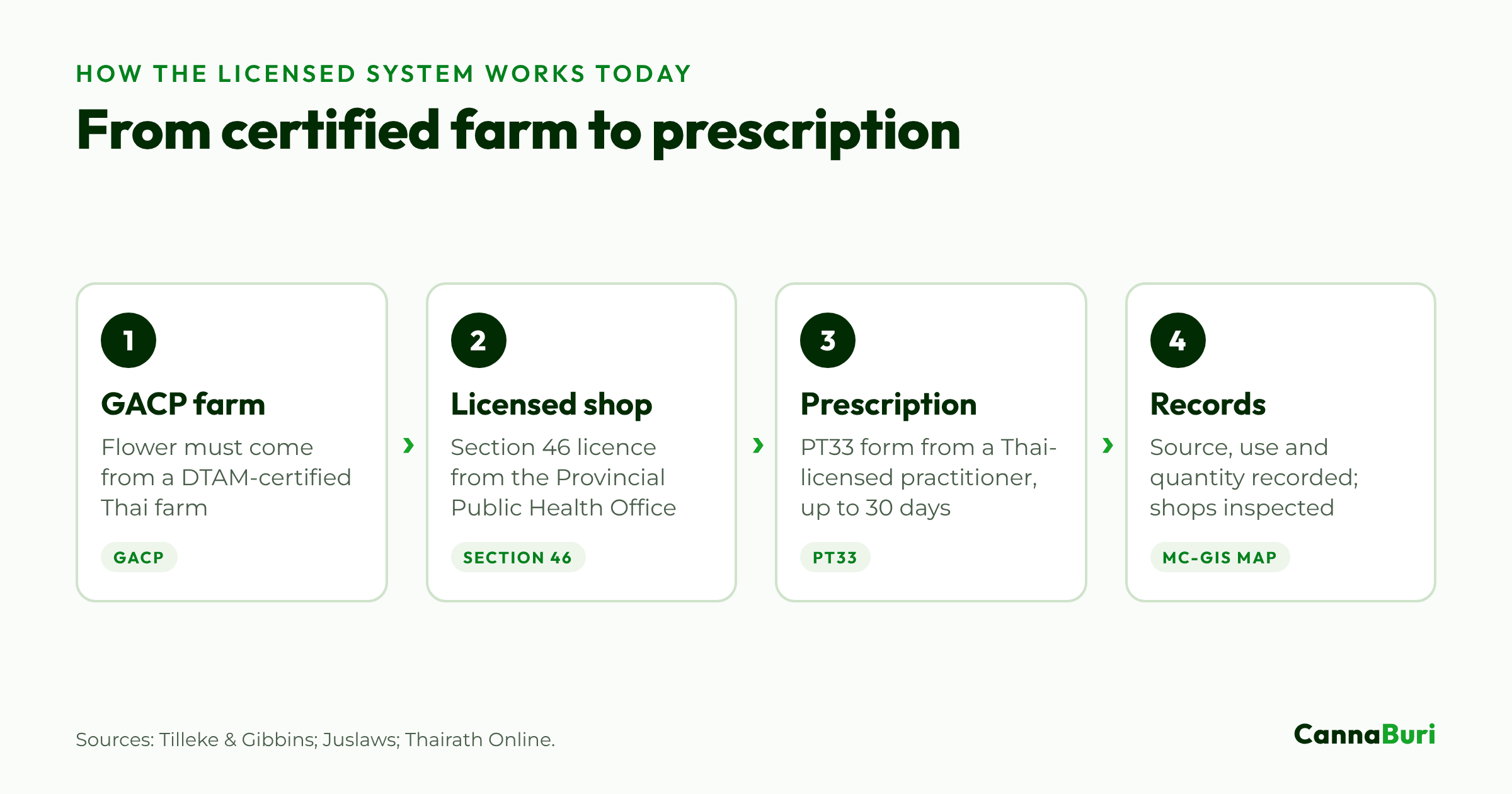
Selling cannabis flower requires a Section 46 licence. In Chonburi province, which includes Pattaya, licences are issued by the Provincial Public Health Office. Current licences run for three years and expire at the end of 2026, 2027 or 2028. Provincial offices are issuing colour-coded stickers that show each shop’s licence expiry year and an eight-digit establishment code.
Supply chain
Flower in the licensed system must come from a GACP-certified Thai farm, and licensees must record the source, use and quantity of everything they hold. Our guide to what GACP and CoA mean explains these certificates.
Prescriptions
Prescriptions can be issued on the official PT33 form by medical doctors, Thai traditional and applied Thai traditional medicine practitioners, folk healers, Chinese medicine practitioners, pharmacists and dentists. Shops must check the buyer’s identity and the prescriber’s details, and keep each prescription for at least a year. Our page on cannabis rules in Thailand for visitors explains what this means for buyers.
Inspection and enforcement
By late May 2026, the Ministry of Public Health reported that 9,158 cannabis establishments had been inspected nationwide, with 2,149 licences suspended, 418 revoked and 394 offenders prosecuted. DTAM’s online MC-GIS map lets anyone check whether a shop is licensed.
Fewer shops
At the end of December 2025 there were 18,433 cannabis establishments in Thailand. Of the 8,636 licences that expired during 2025, only 1,339 renewal applications were filed, leaving an estimated 11,136 establishments.
What could change next
The draft Cannabis Control Bill approved by the Cabinet on 22 September 2026 would limit cannabis strictly to medical use, require cultivation sites to register by size, require shops that are not medical facilities to become one before renewing their licences, and introduce tougher penalties. It now goes to the House of Representatives and is not yet law. We will update this timeline as it progresses.
This is a policy overview, not health information. Research into cannabis is ongoing and the evidence on many questions is limited. If you are considering cannabis for any health reason, speak to a Thai-licensed medical practitioner.
Key takeaways
If you would like to know more about how a licensed dispensary operates, you are welcome to visit our store on Pattaya 3rd Road or contact the CannaBuri team with your questions.
This article is general information, not legal or medical advice.
Sources
- Thai Law Online: Is Marijuana Legal in Thailand? Cannabis Laws in 2026 Explained
- The Star: Thailand moves to rein in cannabis industry, reverse decriminalisation policy
- Bangkok Biznews: Royal Gazette publishes new Ministry of Public Health notification on cannabis flower (Thai)
- Thai Senate: Cannabis no longer "free" under the new controlled herb notification (Thai)
- Tilleke & Gibbins: Thailand's New Cannabis Controls Impact Doctors, Dispensaries, and Growers
- Juslaws: New Thailand Cannabis Law Published on April 30, 2026 (Ministerial Regulation No. 2 B.E. 2569)
- Asia News Network: Thai ministry tightens penalties for cannabis shop rule breaches
- Pattaya Mail: Thailand targets cannabis traffickers with new 30,000-baht-per-kilo penalty
- The Nation: Thai cabinet endorses draft cannabis control bill for medical use
- Thairath Online: Cannabis shop inspections, licence stickers and the MC-GIS map (May 2026)
- Asia News Network: 7,000+ cannabis shops in Thailand close as rules tighten
