


Visiting a Cannabis Dispensary on Pattaya 3rd Road: What to Expect
23/10/2026
Cannabis Product Forms Explained, With Thai Legal Notes
24/10/2026Last updated October 2026.
Green Dream is listed in strain databases, but there is very little verifiable information about it beyond its reported parents: no named breeder, no release date and no published lab data. That makes it a useful worked example for this short guide to reading any strain description, and to checking THC and CBD on a certificate of analysis (CoA).
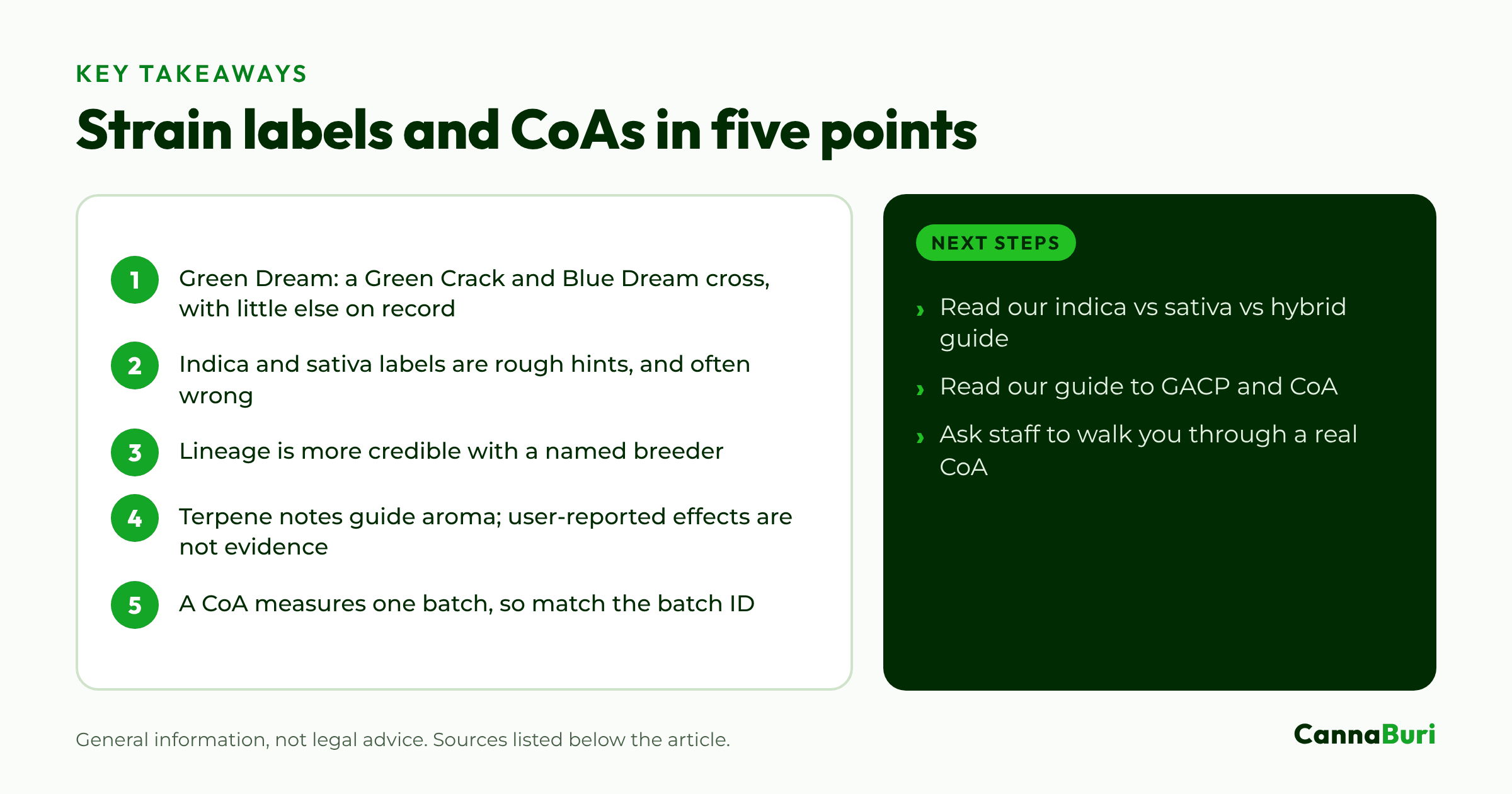
At a glance
- Leafly lists Green Dream as a sativa-dominant hybrid of Green Crack and Blue Dream, and little else is on record.
- Indica, sativa and hybrid labels are mostly marketing shorthand, and research found them usually wrong.
- Terpene notes are a guide to aroma; user-reported effects are anonymous self-reports, not clinical evidence.
- A CoA is a lab measurement for one batch, so its batch ID should match the product.
What we can say about Green Dream
Leafly lists Green Dream as a sativa-dominant hybrid, a cross of Green Crack and Blue Dream. Its listed flavours are tea, rose and menthol, and its most abundant terpene is given as pinene, followed by myrcene and caryophyllene. That is about as far as the documented record goes.
The parents are better documented:
- Green Crack: listed by Leafly as a sativa, bred from Skunk #1 and an unknown indica. Because its name carries a negative image, some people call it Green Cush instead.
- Blue Dream: listed by Leafly as a sativa-dominant hybrid from California, a cross of Blueberry and Haze.
If a strain’s own history is thin, its parents tell you roughly what family it belongs to, but not much more. That brings us to the bigger question.
How to read a strain description
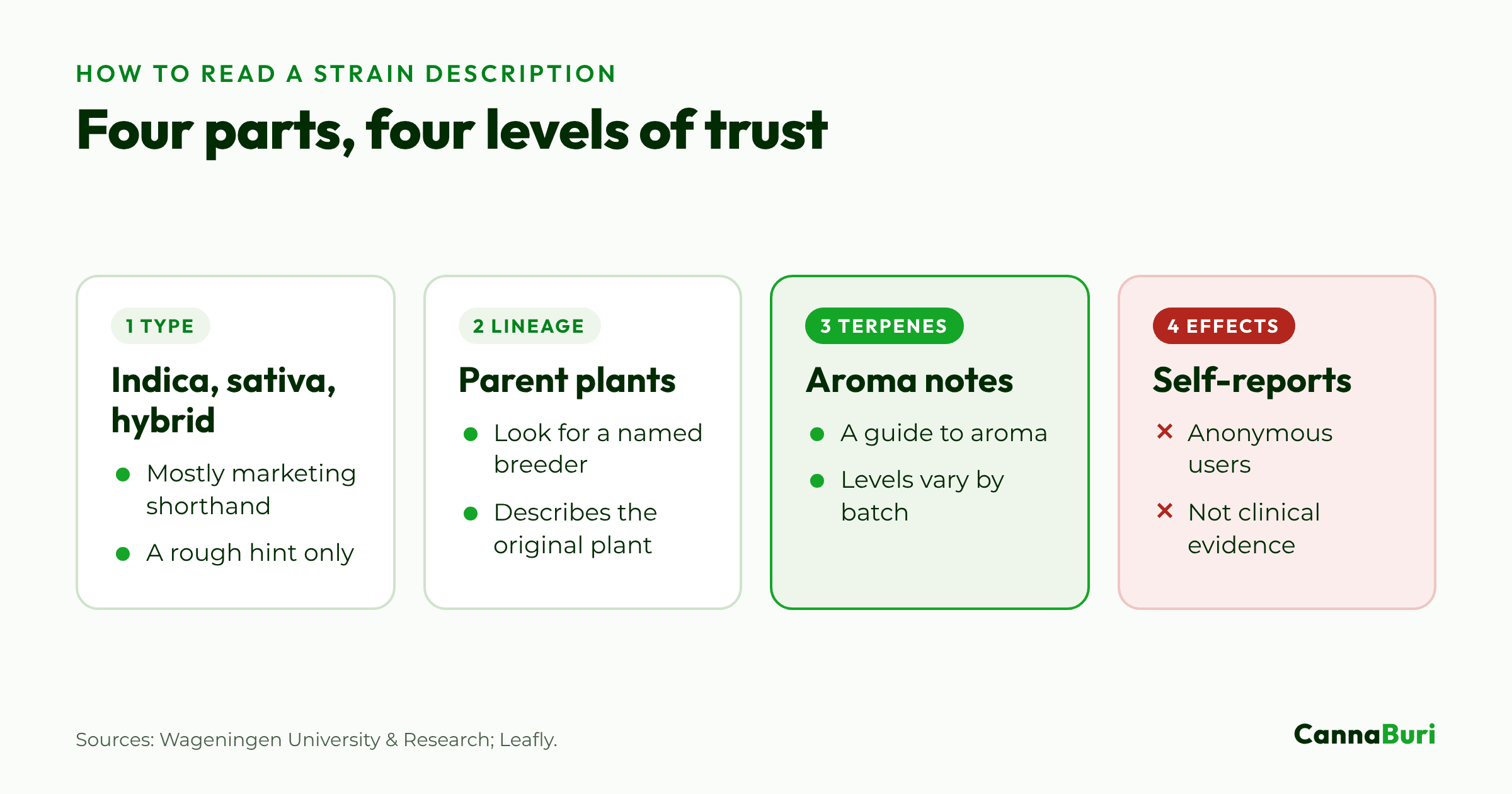
Most strain descriptions, whether on a menu, a seed bank listing or a database, contain the same four parts. Each one deserves a different level of trust.
1. Type: indica, sativa or hybrid
These labels started as botanical terms and are now mostly used as marketing shorthand. A study by Wageningen University & Research and Dalhousie University, published in Nature Plants, found the labels are usually wrong and misleading: you cannot tell from a plant’s genetics or chemistry whether it was sold as an indica or a sativa. Our indica vs sativa vs hybrid guide covers this in more detail.
2. Lineage
Lineage tells you which plants were crossed. Look for a named breeder and a consistent story across sources: phrases like “unknown indica” are common and honest, but be wary of long, colourful ancestries with no breeder behind them. The same study found that products sold under the same strain name can be as genetically different as products with different names, so lineage describes the original plant, not necessarily the one in front of you.
3. Terpene and aroma notes
Terpenes are the aromatic compounds that give cannabis its smell, such as earthy myrcene or pine-scented pinene. Database terpene lists are a reasonable guide to aroma, but levels vary between growers and between batches. The Wageningen researchers recommend that consumers rely on a product’s measured terpene profile rather than its label.
4. Reported effects
Many databases show effects reported by users, sometimes with lists of conditions people say a strain is good for. These are anonymous self-reports, not clinical evidence, and we suggest ignoring any health-related lists.
Research on cannabis and health is ongoing and evidence is limited. If you have a health question, speak to a Thai-licensed medical practitioner.
Reading THC and CBD on a CoA
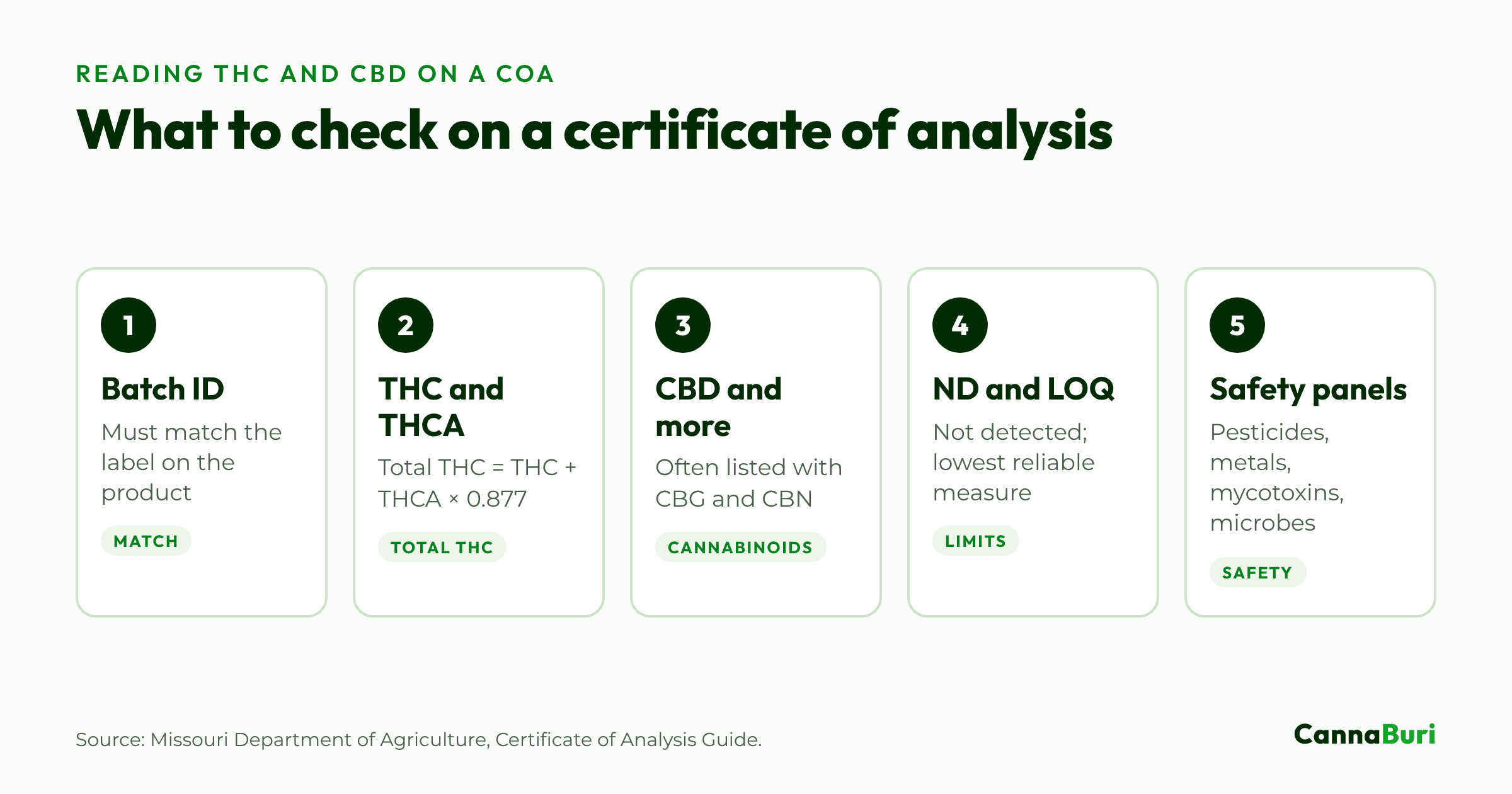
A strain name is a story; a certificate of analysis is a measurement. A CoA is a laboratory’s report of test results for a specific batch, and these are the parts to look for:
- Batch or sample ID: it should match the label on the product. A CoA for a different batch tells you nothing about this one.
- THC and THCA: THCA is the form found in raw flower, and it becomes THC when heated. Labs often report a “Total THC” figure, calculated as THC plus THCA multiplied by 0.877.
- CBD and other cannabinoids: CBD is usually listed next to THC, often with other cannabinoids such as CBG and CBN.
- ND and LOQ: “ND” means not detected. LOQ (limit of quantitation) is the lowest amount the lab can reliably measure.
- Safety panels: many CoAs also cover pesticides, heavy metals, mycotoxins and microbial contamination.
- Terpenes: not every CoA includes them, but when it does, this is the most reliable guide to aroma.
Our page on what GACP and CoA mean explains how lab testing fits with GACP certification, the standard used for a GACP-certified Thai farm.
A quick checklist
Putting the two halves of this guide together:
- Type: read the label as a rough hint only.
- Lineage: check whether it has a named breeder.
- Terpenes: use the notes as a guide to aroma, not to effects.
- Reported effects: skip user-reported health claims.
- CoA: ask for it and check that the batch number matches.
A note on Thai law
Since June 2025, cannabis flower in Thailand has been a controlled herb. Licensed shops may only supply it to adults aged 20 or over who hold a prescription or medical certificate from a Thai-licensed practitioner, covering no more than 30 days. It may not be supplied to pregnant or breastfeeding women, smoked in public places or on shop premises, or taken out of the country. Sales through websites, apps and other electronic channels, and advertising in any channel, are also prohibited.
The rules are still moving. In September 2026 the cabinet approved a draft cannabis control bill that would limit cannabis to medical use; it now goes to parliament. Our guide to cannabis rules in Thailand for visitors is kept up to date.
Key takeaways
If you would like someone to walk you through a real CoA, you are welcome to visit our store on Pattaya 3rd Road or contact the team. We are happy to explain what each line means.
This article is general information, not legal or medical advice.
Sources
- Leafly: Green Dream strain
- Leafly: Green Crack strain
- Leafly: Blue Dream strain
- Wageningen University & Research: Cannabis labels often wrong and misleading
- Missouri Department of Agriculture: Certificate of Analysis Guide
- The Nation: Thailand strengthens controls on cannabis flower sales and exports (July 2026)
- The Nation: Thai cabinet endorses draft cannabis control bill for medical use (September 2026)
- Thailand Starter Kit: An Expat’s Guide to Cannabis in Thailand (updated July 2026)
