


Why Cannabis Seedlings Struggle: Common Causes Explained
24/10/2026
CBD vs THC: Chemistry, Legal Status and Lab Labels
24/10/2026Last updated October 2026.
Ask people who use cannabis and many will tell you that no two strains are quite alike. Some of the differences can be explained by chemistry, some cannot be explained yet, and some may come down to labels that are less reliable than they look. This article takes a careful, evidence-based look at the chemistry, the labels and the limits of the research, and it is not health advice.
At a glance
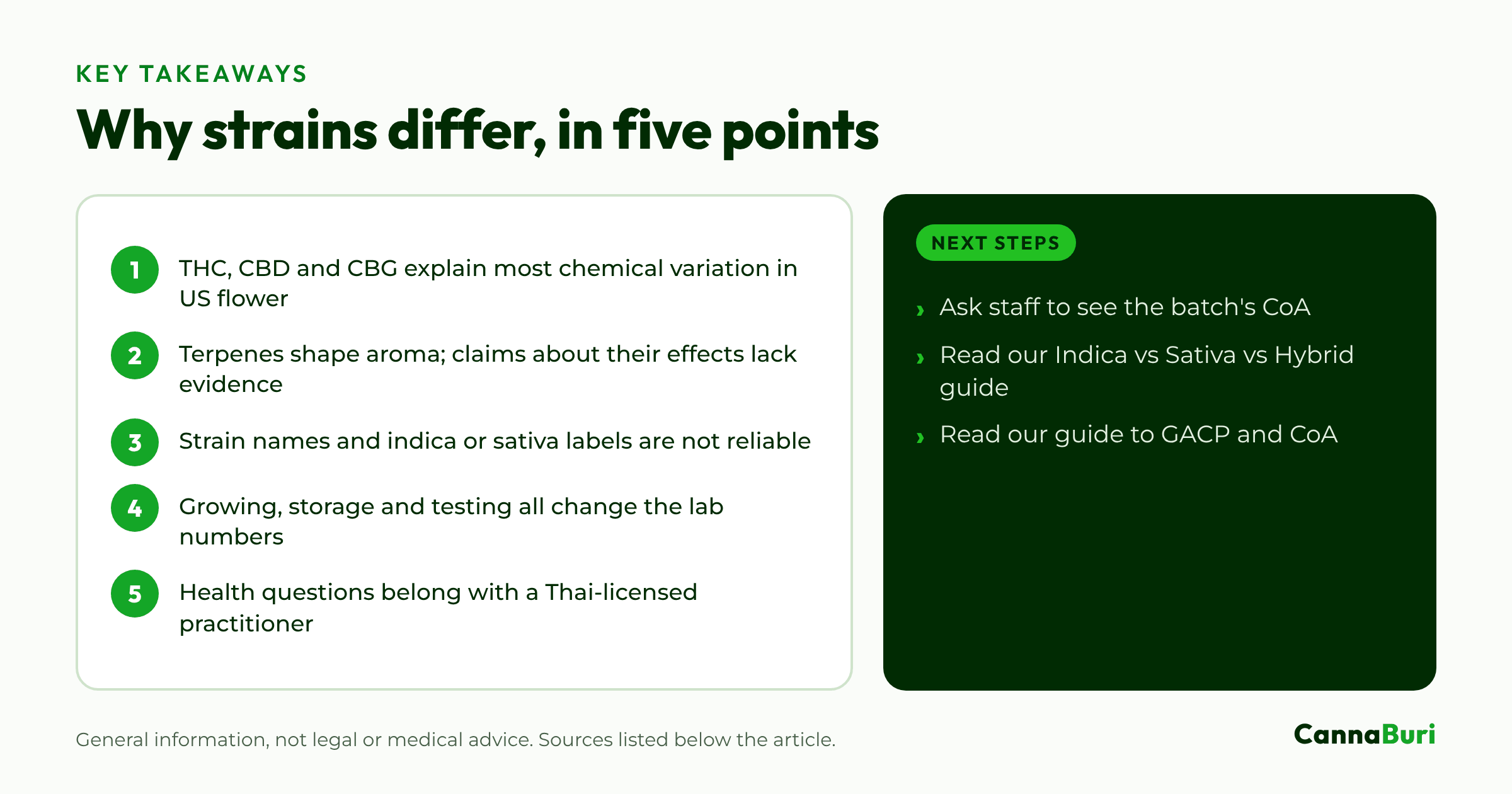
- In a study of 89,923 US flower samples, three cannabinoids (THC, CBD and CBG) explained most of the chemical variation.
- Terpenes give each strain its smell and flavour; claims about their effects are not supported by the evidence.
- Strain names and indica, sativa and hybrid labels do not reliably match genetics or chemistry.
- Growing conditions, storage and the test itself all change what a lab report shows.
Cannabinoids: the biggest known variable
Cannabinoids are the compounds most closely studied in cannabis, and THC is the most studied of all. It acts as a partial agonist at the CB1 and CB2 cannabinoid receptors and is the compound responsible for the intoxicating effect of cannabis.
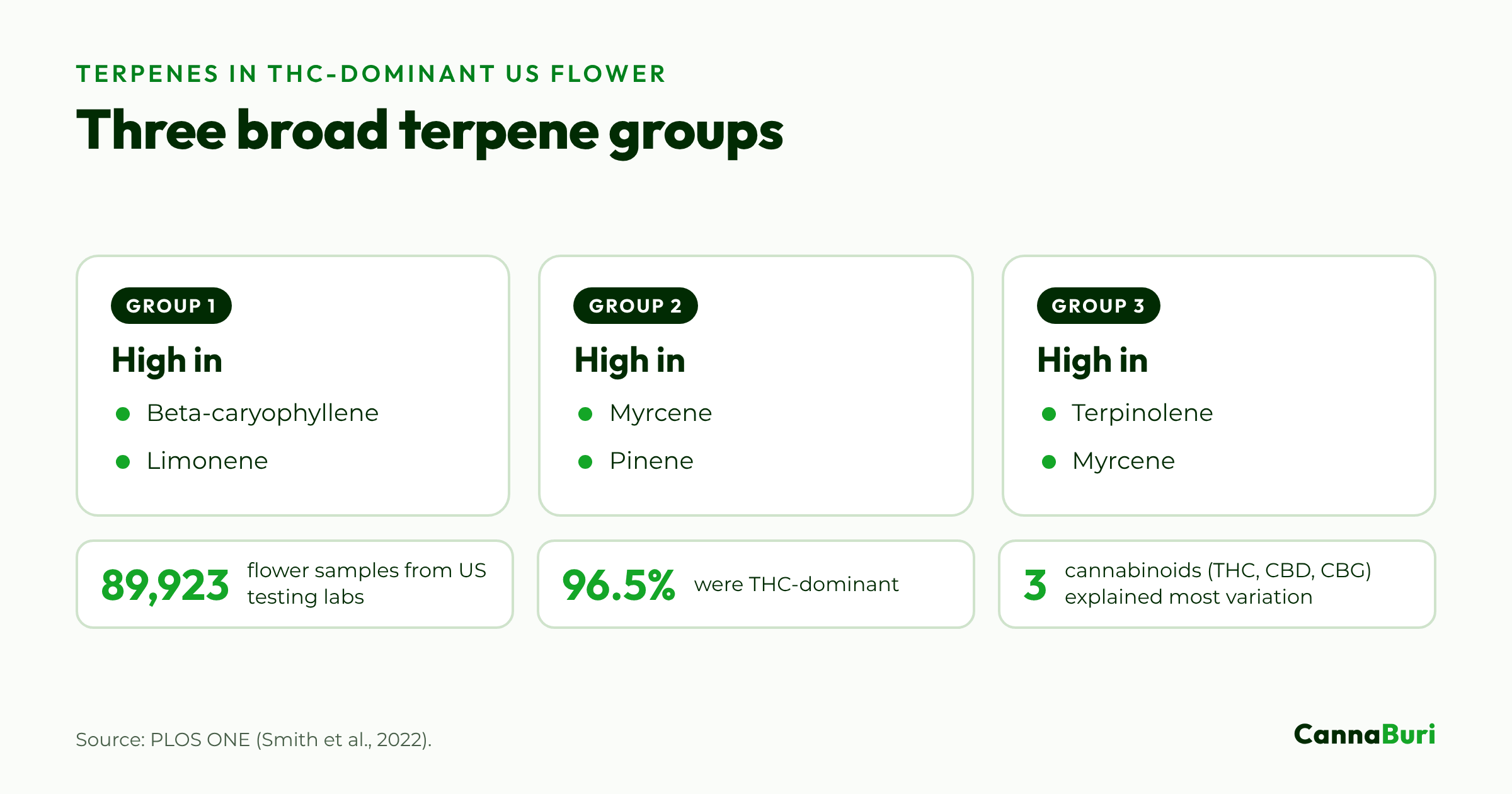
The clearest chemical difference between products is simply how much THC, CBD and other cannabinoids they contain. A study of 89,923 flower samples from US testing labs found that 96.5% were THC-dominant, and that most of the chemical variation between them was explained by just three cannabinoids: THC, CBD and CBG.
Does more CBD offset THC?
A common idea is that CBD balances THC. A 2022 trial at King’s College London tested this directly: forty-six volunteers inhaled cannabis with the same amount of THC and either no CBD or one of three larger amounts. None of the CBD levels protected volunteers from THC’s acute negative effects, and the only clear change was more coughing as the CBD content rose.
That does not settle every question, but it is a good reminder that popular beliefs about cannabinoid ratios are often ahead of the evidence.
Terpenes: aroma is certain, effects are not
Terpenes give each strain its smell and flavour. The same US study found that most THC-dominant flowers fell into three broad terpene groups: one high in beta-caryophyllene and limonene, one high in myrcene and pinene, and one high in terpinolene and myrcene.
Many websites go further and claim each terpene produces a specific effect, sometimes linked to the idea of an entourage effect. The evidence is limited. A laboratory study tested five common cannabis terpenes and found no data to support the idea that they act directly on the CB1 or CB2 receptors, except possibly a weak interaction between beta-caryophyllene and CB2, and the authors suggested other mechanisms should be investigated. Research is ongoing, so we regard claims about terpene effects with caution.
The limits of strain names
Strain names are a marketing and breeding shorthand, not a scientific classification, and the research shows their limits. Three findings stand out.
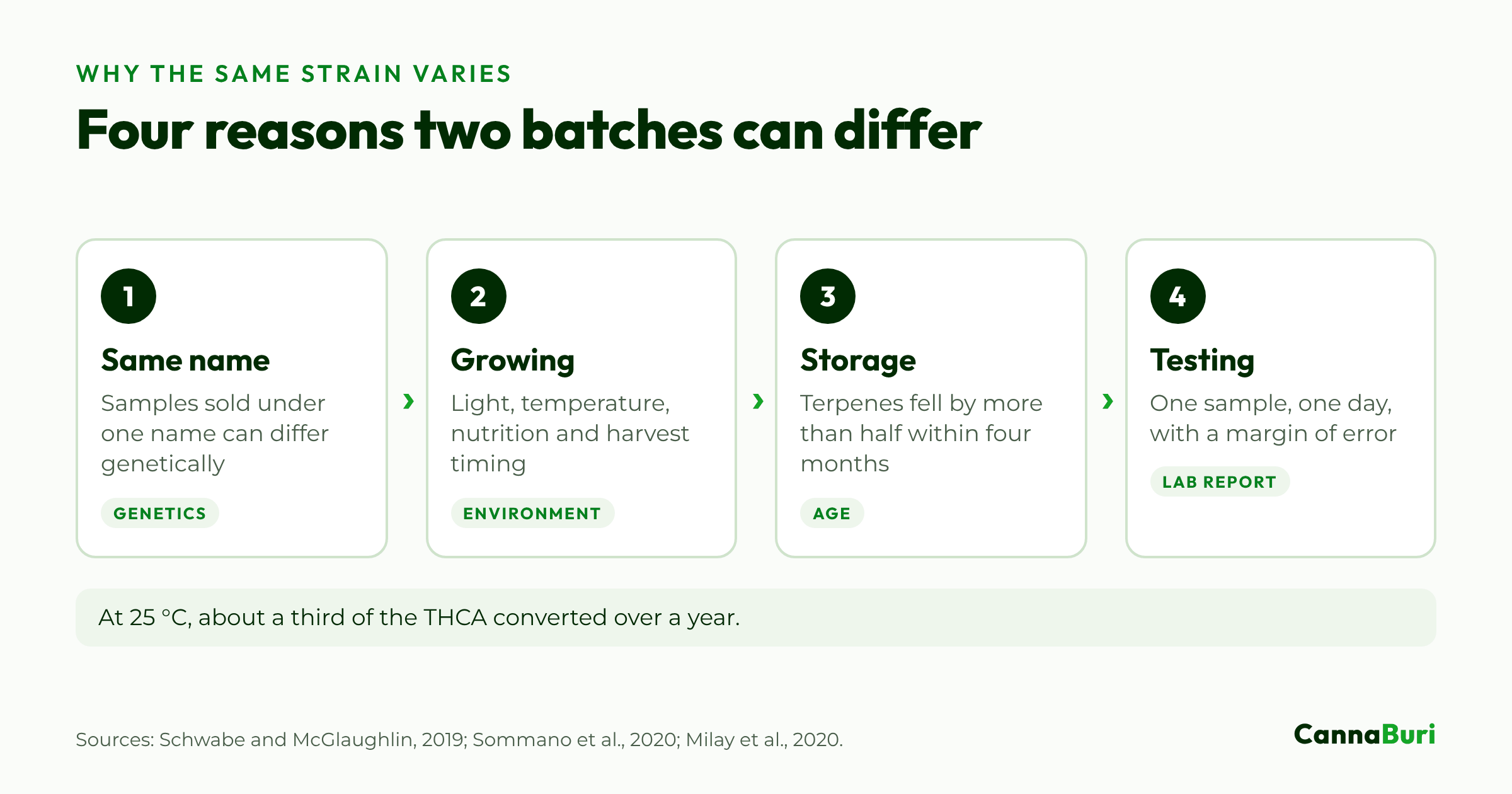
- Same name, different plant: a genetic study of 122 samples sold under 30 strain names in three US states found that most strains contained at least one genetic outlier. Even strains sold as clone-only showed differences between samples.
- Indica, sativa and hybrid labels: the same genetic study found no clear genetic support for the commonly used sativa, indica and hybrid types. The large US chemistry study reached a similar conclusion: these labels do not consistently line up with the chemical makeup of the flower.
- Some names are more reliable than others: the chemistry study did find that many strain names were more consistent than chance, but the range was wide.
Our Indica vs Sativa vs Hybrid guide explains where those labels came from and what they can and cannot tell you.
Why the same strain varies
Even with identical genetics, two harvests are rarely chemically identical. Three things shift the numbers.
Growing conditions
A peer-reviewed review of cannabis terpenes describes terpene composition as a seasonal variable that depends on environmental conditions, plant part and maturity. Light, temperature, nutrition and harvest timing all shift the balance of compounds. This is one reason the record-keeping required on a GACP-certified Thai farm matters.
Storage and age
Chemistry keeps changing after harvest. In a one-year storage study, average terpene levels in dried flower fell by more than half within four months. At 25 °C, about a third of the THCA in THC-rich flower converted over the year, and CBN slowly increased. Ground flower lost more terpenes than whole flower, so a batch tested at harvest may not match the same batch several months later.
The test itself
Lab results are a snapshot of one sample on one day, and every measurement has a margin of error. Comparing results across different labs adds further variation.
What this means in practice
Taken together, the research suggests reading strain names and descriptions with care. Three habits follow from it.
- Look at the lab report, not just the name: the certificate of analysis shows the cannabinoid and terpene content for that batch. Our guide to what GACP and CoA mean explains how to read it.
- Read descriptions as aroma notes: a description of a strain’s smell and flavour is useful. A promise about how it will make you feel is not something the evidence supports.
- Ask the right person: in Thailand, cannabis flower is now supplied only against a valid prescription from a Thai-licensed practitioner, and questions about your health belong with that practitioner.
Nothing in this article suggests that any strain is suitable for any condition. For health questions, please speak to a Thai-licensed medical practitioner.
Key takeaways
If you would like to talk any of this through, you are welcome to visit our store on Pattaya 3rd Road or contact the CannaBuri team with your questions. Our team can show you the lab results for any batch and explain what the numbers mean.
This article is general information, not legal or medical advice.
Sources
- Wikipedia: Tetrahydrocannabinol
- PLOS ONE: The phytochemical diversity of commercial Cannabis in the United States (Smith et al., 2022)
- King’s College London: Cannabis not made safer by increasing its CBD content (2022)
- Frontiers in Pharmacology: Terpenoids from cannabis do not mediate an entourage effect by acting at cannabinoid receptors (Finlay et al., 2020)
- Journal of Cannabis Research: Genetic tools weed out misconceptions of strain reliability in Cannabis sativa (Schwabe and McGlaughlin, 2019)
- MDPI Molecules: The Cannabis Terpenes (Sommano et al., 2020)
- Frontiers in Plant Science: Metabolic profiling of cannabis secondary metabolites for evaluation of optimal postharvest storage conditions (Milay et al., 2020)
- Tilleke & Gibbins: Thailand’s cannabis reset, dispensaries to clinics (January 2026)
- Tilleke & Gibbins: Thailand’s new cannabis controls impact doctors, dispensaries and growers (September 2025)
